In frontline Zaporizhzhia, children learn early to tell sounds apart: thunder from an explosion; the moment when it’s safe to breathe out, and when it’s better to stay tense. Their childhood unfolds between bomb shelters, air-raid sirens, and fragmented learning — interrupted by power outages and news from the front. They live in a state of constant alertness. From the outside, it may look like resilience — they’re holding on. Inside, it often means exhaustion, anxiety, and a deep sense of instability.
This emotional background does not disappear when a lesson begins. It follows children into classrooms and onto screens, drains their energy, and affects their concentration, memory, and ability to learn. Over time, it becomes one of the causes of learning loss — not only the kind measured in missed topics, but also the kind born of living under constant threat. These losses are not always immediately visible in grades, yet they are already shaping these children’s futures.
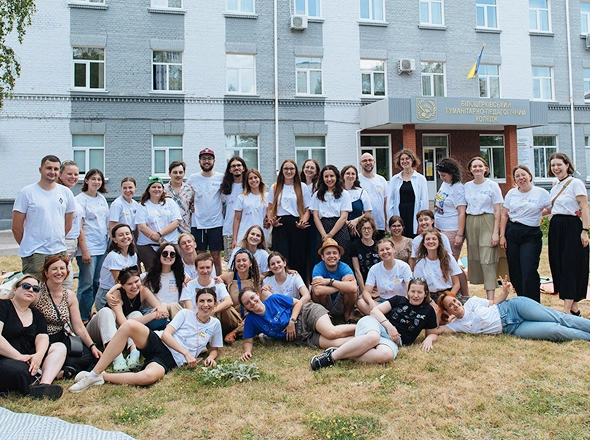
The teenage mental health ambassador team “Impulse” at Zaporizhzhia Collegium “Elint” aims to turn school into a space where students feel heard. They talk with their peers about communication without judgment, about emotions that don’t need to be hidden, and about support that grows through peer-to-peer connection.
In just the first few months of participating in the program, five “Impulse” ambassadors have already carried out dozens of activities at their school — from creative workshops to deep conversations about emotions, stress, and aggression. Most importantly, they have seen genuine responses from their peers, for whom these meetings have become safe spaces for self-expression.

One such activity, held just before the winter holidays, was called “The Emotions Box.” Together with fifth graders, the ambassadors created small personal boxes where children could place something positive — thoughts, impressions, or words of support for themselves. In another class, students made paper houses that could be lit with a flashlight, revealing a warm light inside.

We received a lot of feedback,” one of the ambassadors shares. They said things like: ‘I really liked this lesson and the vibe,’ ‘It was fun making the box,’ ‘Everything was so cool,’ ‘The helpers are the best.’ They even called us fairies — I think because of the good mood and the sense of celebration we brought into the classrooms.”


Alongside creative activities, the team regularly holds meetings focused on emotions with fifth- and seventh-grade students, both online and offline. The format is simple but effective: conversation, questions, shared exercises, and space to speak up.
“We’ve noticed that for many children, this is an important space at school where they feel listened to and where their feelings are taken seriously. That’s why the feedback often goes beyond a single activity — children come up to us in the hallways, hug us, and ask if we’ll come again. It matters to them that someone talks to them about what they’re feeling — about stress, anger, and anxiety. And that this conversation happens not from the top down, but on equal terms,” the ambassadors explain.
During one such meeting, a fifth-grade student asked how to deal with aggression.
“We talked about the fact that aggression doesn’t need to be suppressed — it needs to be experienced and redirected: into movement, sports, drawing, or even simple actions like tearing a sheet of paper or hitting a pillow. These are small but very practical tools that help keep both yourself and others safe.”
The team also highlights another important issue: misunderstandings between children and adults. Students often say they don’t always understand why they are being scolded and feel they lack explanations. The ambassadors see this as a point of growth — for children, teachers, and the entire school community.


“Impulse” works on a peer-to-peer principle, and this is one of its core values. Teenagers are more likely to open up to those closer to them in age — people they find easier to trust, without hierarchy.
The ambassadors themselves admit that this interaction inspires them just as much as it supports the children. They learn alongside the participants, rethink their own emotions, and become more attentive to themselves and others.
“We’re inspired by the children’s emotions, their feedback, and their honesty. When they ask for more meetings, you realize this work truly matters,” the team members say.
Despite challenging conditions — power outages, lack of time, and skepticism from some adults — the team keeps going. Even more ideas are emerging: working with different age groups, involving teachers, and building that much-needed “bridge” between children and adults.
Our task as adults is not only to support one-off initiatives by young people, but to build a process in which teenagers learn to speak about themselves, listen to others, and support one another.
Because it is from such impulses that big change begins.
- Prolonged fatigue and stress have a negative impact on cognitive processes: 41% of adolescents report difficulties with concentration, 40% with memory, and 34% with thinking.
- At the same time, 44% of respondents demonstrate a high level of intrinsic motivation to learn. This motivation is largely supported by clearly defined goals—most often, adolescents mention successfully passing the National Multidisciplinary Test (NMT) and gaining admission to higher education institutions.
- Parents remain the primary source of emotional support (44%), followed by friends and peers (24% of respondents).
The study involved 3,415 adolescents aged 14–16, as well as parents, teachers, and school psychologists from eight frontline regions of Ukraine: Dnipropetrovsk, Zaporizhzhia, Kyiv, Mykolaiv, Sumy, Kharkiv, Kherson, and Chernihiv regions. The research combined qualitative and quantitative methods, enabling a comprehensive assessment of how war affects adolescents’ emotional well-being and their ability to learn.
The mental health ambassador program “Impulse”, implemented by Teach For Ukraine, is carried out within the framework of the Multi-Year Resilience Programme (MYRP) 2024–2026 and is funded by Education Cannot Wait (ECW)—the UN’s global fund supporting education in emergencies and protracted crises.
The MYRP in Ukraine is implemented with the support of the Ministry of Education and Science of Ukraine.