Author: Eleonora Burdina for DOU.ua
“The Redheaded Idea Generator” — that’s what one of her classmates called Yulia Zdanovska. Yulia repeatedly won national and international competitions in computer science and mathematics, and took silver at the European Girls’ Mathematical Olympiad. A teacher, a mathematician, a volunteer — she dreamed of becoming an education reformer.
On March 3, 2022, a Russian missile cut short the life of 21-year-old Yulia. Olympiads are held in her memory, and prizes and scholarships have been established in her name. As early as 2022, the Massachusetts Institute of Technology launched the Yulia’s Dream program to support talented Ukrainian high schoolers.
Brave, decisive, vivid, unconventional — that’s how her family, colleagues, and friends describe her. We spoke with them to tell Yulia’s story.
Yulia was born in Kharkiv. Her father works in IT development for banking systems; her mother has volunteered since 2014 and now heads the charitable foundation “Station Kharkiv.”
According to Yan Zdanovsky, his daughter was curious about everything from early childhood. Her independence and stubbornness showed early on: it was difficult to make Yulia do anything.

“There’s a 15-year gap between us,” says her older sister Olha Vynnyk. “I never really thought of her as a sister — to me she was my ‘first child.’ She was different from other kids in a lot of ways. From around age five, we’d discuss things like love and death — subjects that don’t usually interest small children.”
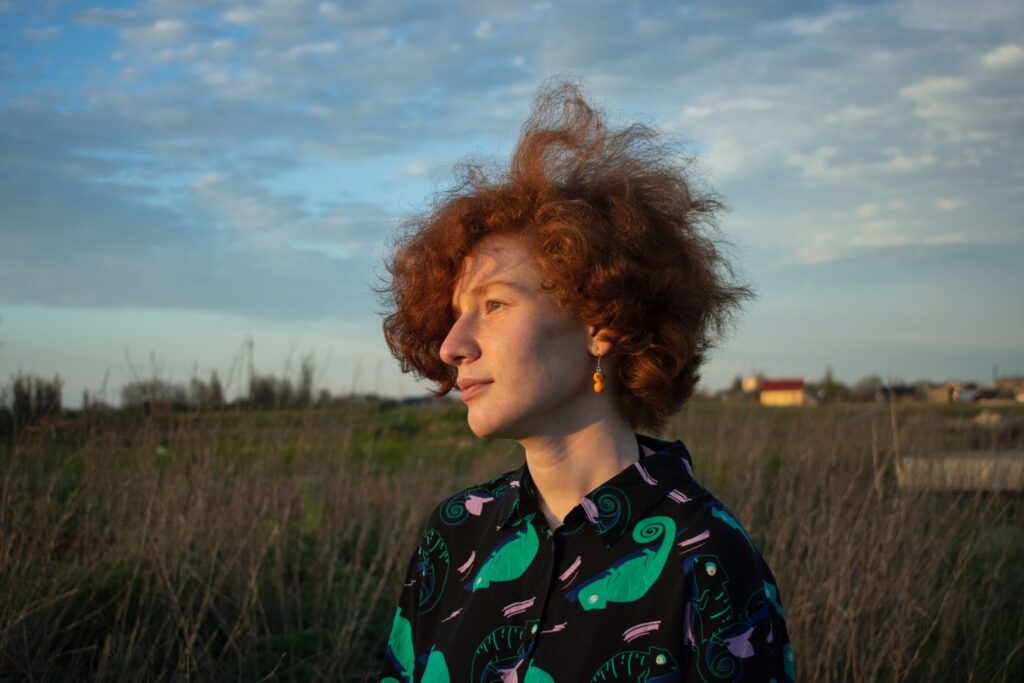
Yulia Zdanovska drew attention with her looks: fiery red hair, blue eyes. People noticed and remembered her instantly.
“She was this little ray of sunshine — inside and out,” says Yulia’s father, Yan Zdanovsky.
“What struck you first was her appearance,” recalls Bohdan Rublyov, a professor at Kyiv National University and head of the Ukrainian Mathematical Olympiad. “She was so multifaceted I wouldn’t even attempt to describe it — every time you met her, it was like meeting a new person. And beneath that, her deep inner world revealed itself: unconventional thinking, a drive to fight injustice and wrongdoing, a wide range of interests and passions.”
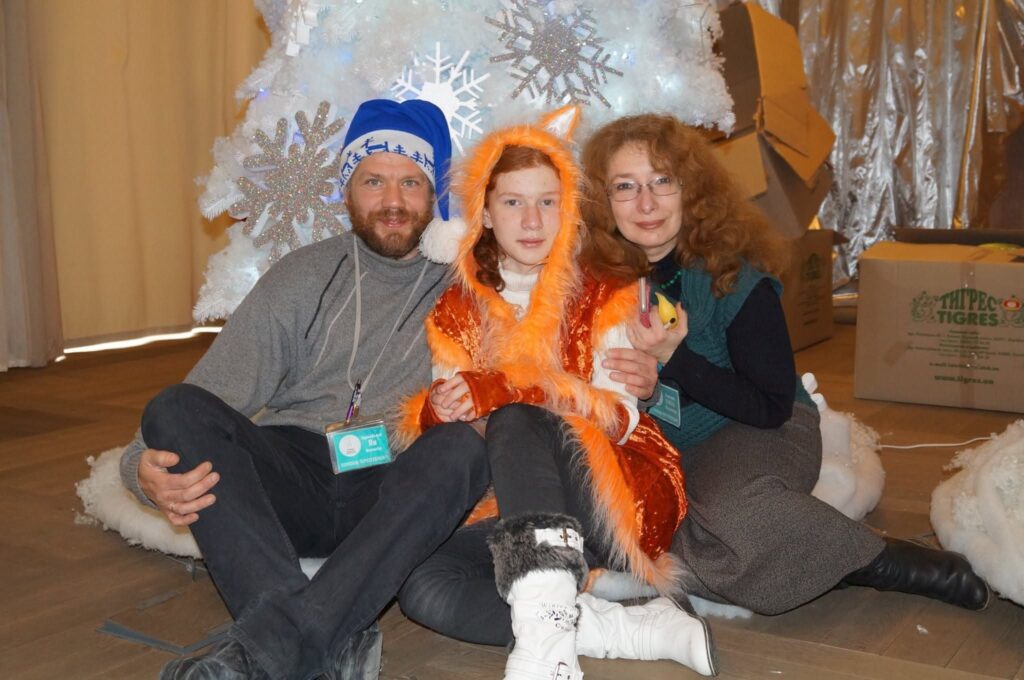
Yulia with her parents
Even brief contact with Yulia left a lasting impression. Viktor Ivanov taught classical guitar. Yulia joined his class in 2012 and studied for a month before he left the music school. But even 14 years later, he singles her out among the dozens of students he’s taught:
“I remember her as an extremely decent, meticulous, disciplined person. In eight or nine lessons she mastered what it takes others a year to learn. She reminded me of a sports car that goes from zero to a hundred kilometers an hour in three seconds. Sometimes a 45-minute lesson drags on and time seems to stop. With Yulia it was completely different — there was a real give-and-take, a resonance.”
Yulia had many interests: she drew, made things with her hands, and loved watching films and reading from an early age.
“That’s something we have in common,” her sister says. “We’re both voracious readers — all kinds of books, detective novels, contemporary literature. I remember putting together her first collection — Harry Potter and similar children’s fantasy.”
As Olha recalls, numbers fascinated her sister more than letters even as a small child — she used to mold them out of modeling clay. But for first grade she was sent to an arts lyceum.
“It mattered that my wife and older daughter had studied there,” says Yan Zdanovsky. “Yulia even played a little fox in a school play there. But I can’t say she was especially fond of it. At the same time she started attending the ‘Evrika’ math club, and there she really lit up and started showing serious results.
After elementary school, in 2010, we moved her to Physics and Mathematics Lyceum No. 27, well known even beyond Kharkiv. Yulia threw herself into mathematics, a bit less into physics. When computer science started, she got hooked and quickly outgrew what the lyceum could offer her.”
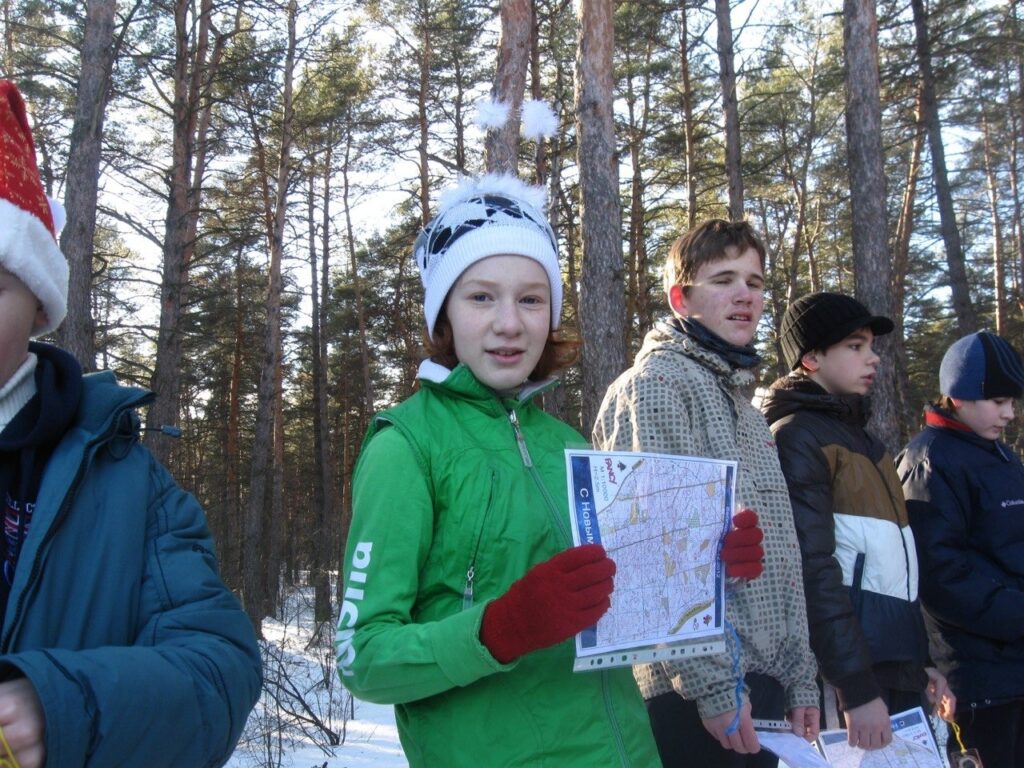
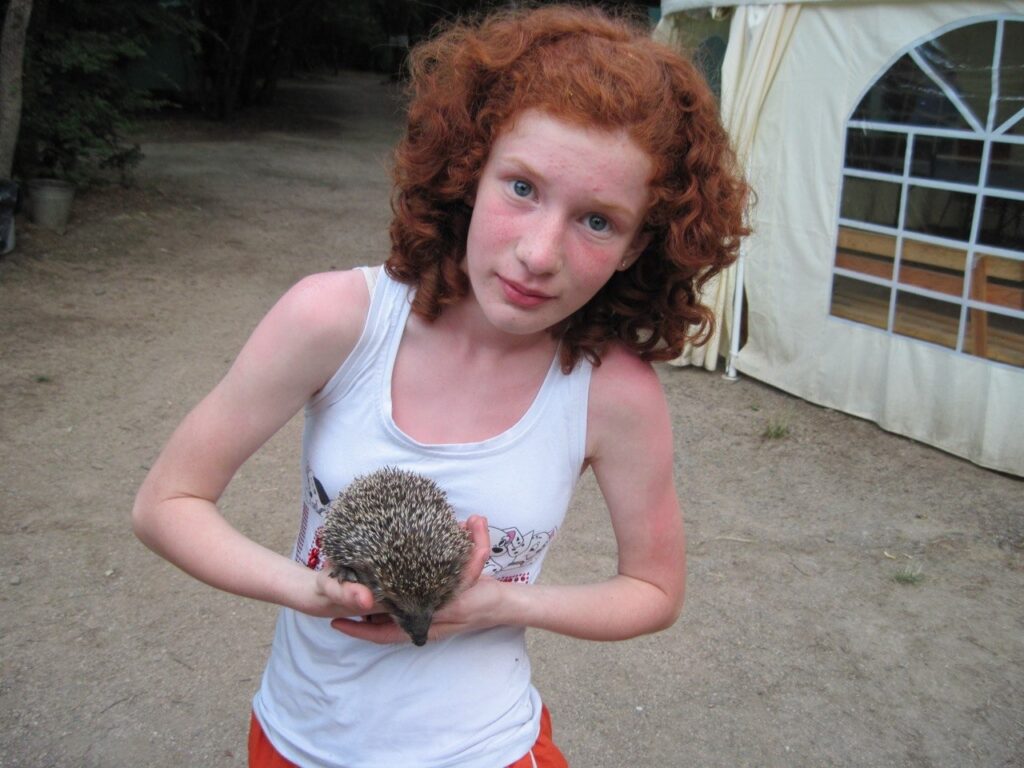
Once, a orienteering coach visited the school and invited students to join a club. That became Yulia’s passion for four years. They traveled every school break, and in summer went to training camps and competitions. Her father believes this habit of traveling, of being away from the family and taking care of herself, prepared his daughter for independent life. So when she was invited to study at the Ukrainian Physics and Mathematics Lyceum in Kyiv, the prospect of living in another city didn’t scare Yulia.
“The lyceum keeps track of olympiad participants,” Yan Zdanovsky explains. “And after one competition Yulia got an unexpected paper letter inviting her to study there. Honestly, I wasn’t thrilled about the idea of my 14-year-old daughter living in another city. But there was no making Yulia do anything without convincing her first. We agreed to go visit and decide afterward.
They were clearly surprised we’d come from Lyceum No. 27. The interview itself was conducted by a very strong computer science teacher, and Yulia saw that here she’d get the computer science education she couldn’t get in Kharkiv. I think that’s what really swayed her decision. That evening when I said, ‘Well, let’s weigh everything, think it over,’ Yulia just said: ‘What’s there to weigh?’”
It was at the lyceum that Yulia met Alina Yan.
“There was a school olympiad where I took first place and Yulia took second, because the hardest final problem was in geometry, which she didn’t love. For me it was the opposite with combinatorics — so once we became friends, Yulia taught me combinatorics and I taught her geometry. As for how we actually met: she came up to introduce herself because she was curious who’d beaten her.
I came to value our friendship more and more over time. There was a long stretch where I’d agree to come along to the supermarket just to have an excuse to walk together and buy snacks.
Everyone who studied at UPML loves it because it’s a boarding school. Yulia compared it to Hogwarts — partly because of that, and partly because of how specialized the school was in specific subjects. That admission letter was also the only paper letter Yulia ever received in her life. She used to say it was such a rarity, as if an owl had delivered it.
At the same time, the lyceum had a lot of strict, senseless rules, and Yulia was constantly fighting for fairness, trying to protect everyone. For instance, one teacher ordered a classmate of hers to take off her jacket. It was cold in the room because the heating was weak or not working at all. Yulia started arguing and proved the teacher had no right to demand that. There were many stories like that.”
Studying at UPML lived up to Yulia’s expectations. She threw herself into the olympiad movement.
“For her not to make it to the national level in math would have been genuinely strange,” Yan Zdanovsky comments.
Yulia and Alina traveled to math and computer science competitions in Chernivtsi, Zaporizhzhia, Chernihiv, Khmelnytskyi, Rivne, Vinnytsia, and Dnipro.
“Maybe this is a false memory,” her friend recalls, “but on the way to one olympiad in Koncha-Zaspa we traveled by minibus. There weren’t enough seats, so they asked if two people were willing to ride in the luggage compartment, and Yulia and I agreed.
Yulia had wanted a power bank for a long time. Usually at olympiads you get one for second place — a phone or tablet for first, a flash drive for third. And she kept taking either first or third place. Her parents bought her a powerful power bank that could even charge from sunlight, but it broke on the third day. Yulia decided she had to actually win one. But at the next olympiad she took first place again. So she found a boy who’d taken second and traded her tablet for his power bank. That one finally ‘counted,’ because it didn’t break.”
Alina recalls that Yulia loved her laptop and refused to go anywhere — even to the corner store — without it. A few times she did manage to convince her friend to leave it at home.
“But that was exactly when we suddenly wanted to sit on the grass and watch a show. The next time, a window would suddenly open up when we could have done homework instead. After that I lost my voice on the laptop question forever,” Alina says.
The girls also competed internationally. Yulia represented Ukraine twice at the European Girls’ Mathematical Olympiad.
“Yulia and I met before her first trip to Romania for EGMO in 2016,” recalls team leader Yulia Kravchenko. “She was one of our youngest participants at the time — bright, and a little shy. The following year we met again at EGMO, this time in Switzerland. You could feel that she’d grown stronger in the meantime. The olympiad consists of two rounds — days — and on each you have to solve three problems in four and a half hours. You can spend years learning to solve problems like that and still get overwhelmed during the actual competition. So knowing how to steady yourself matters. Yulia had that.”
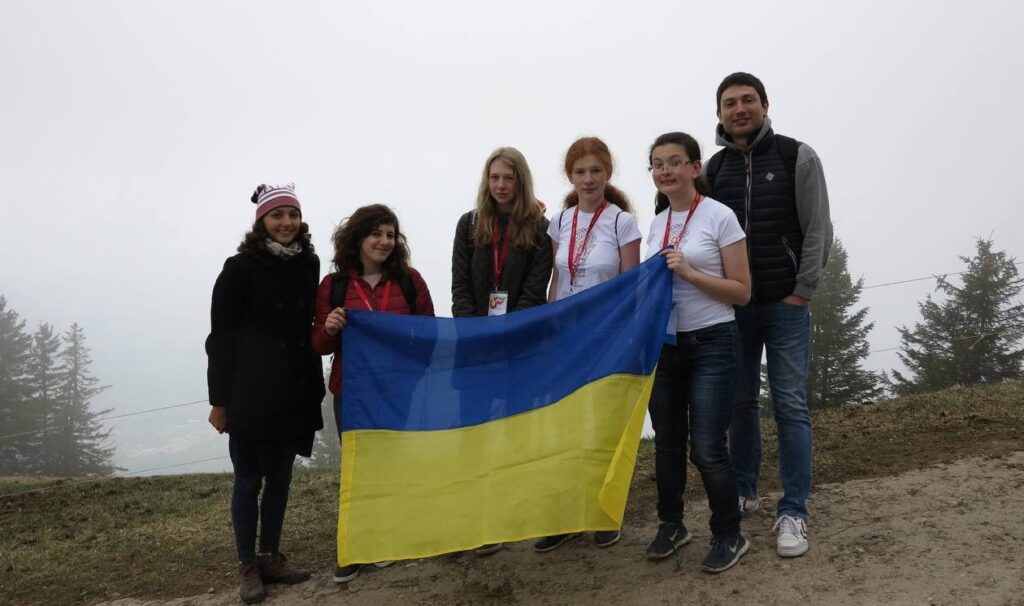
EGMO 2017, Alina Yan beside Yulia
“When we traveled to competitions, we never expected our team to win,” comments Andrii Anikushyn, another team leader. “And that year we were hoping for a solid showing, nothing close to a fight for first place. Unexpectedly, the girls performed brilliantly: two participants from Kharkiv took gold medals, and Yulia and Alina took silver.
At EGMO there’s something called coordination: after the competition, both the team leaders and the international coordinators independently read the papers, and then the two sides have 15–20 minutes to agree on a score for each problem. With around forty teams, coordination takes an entire day. Results appear on the official website in real time, so you can follow along online. Once we’d coordinated four problems, we saw Ukraine sitting in first or second place — neck and neck with the Russian team. Losing even a single point could have been decisive.”
That year Ukraine won the team competition.
“Our team’s score differed from Russia’s by exactly one point,” Yulia Kravchenko adds. “There’s one other moment from that trip I remember: we went on an excursion to the top of a Swiss mountain, it was cold, everyone was a little frozen, but Yulia was perfectly comfortable in a T-shirt. Everyone was urging her to put on something warmer. Yulia, very politely but unshakably, refused and did things her own way.”
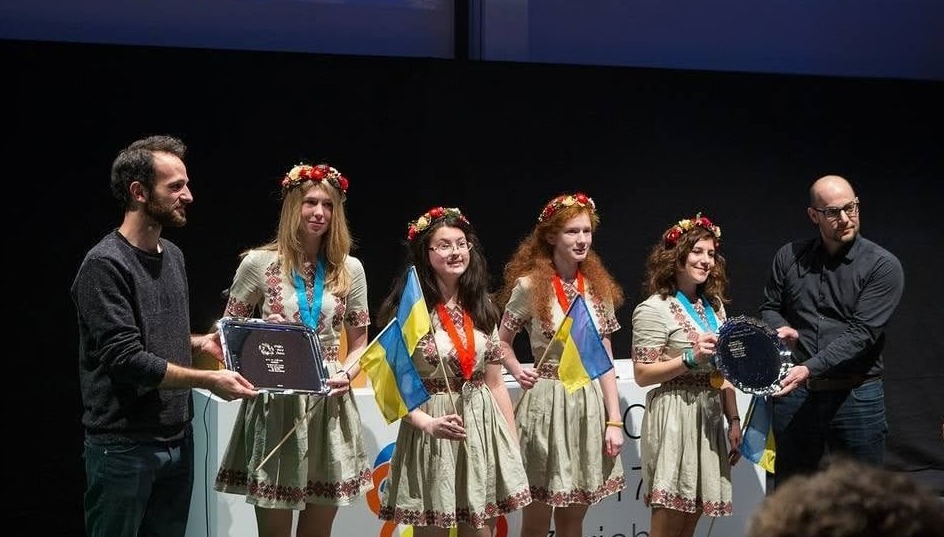
Awards ceremony at EGMO 2017
Andrii Anikushyn wasn’t only Ukraine’s team leader at EGMO — he was also Yulia’s 11th-grade math teacher.
“Yulia Zdanovska had many teachers over the years. Her mathematical path began in Kharkiv, where she had some incredibly strong ones. At UPML, until 11th grade, her math teacher was Viktor Vyshensky, a man who trained generation after generation of olympiad medalists.
The same year our team won at EGMO, Yulia, Alina, and Denys — three students from my class — took part in the final round of the Ukrainian Mathematical Olympiad. That’s not only the top of the national olympiad ladder; among eleventh-graders, the twelve best are selected for the qualifying and training camp for the International Mathematical Olympiad (IMO). Making it to the IMO is the main goal for anyone seriously pursuing olympiad mathematics in school. Denys made the selection. Yulia placed twelfth and advanced; Alina placed thirteenth and didn’t.”
An appeals process follows the competition, in which a participant can try to convince the jury that their work deserves a higher score.
“At that olympiad, it went the other way around. Yulia came to the appeal and said that on one problem she’d been given more points than she deserved. I’m certain 99 out of 100 people in that situation would have sat quietly and been secretly glad for those extra two or three points. If Yulia hadn’t come forward, no one would have noticed anything — the result would have stood, she’d have placed twelfth and made the selection anyway.
The jury reviewed the work, agreed there had been a mistake, and lowered the score. Alina moved up to twelfth place — they swapped positions. I don’t remember another case like that at the finals of the Ukrainian Olympiad — especially not from someone who had a spot on the qualifying team at stake. Alina went to the training camp, and Yulia remained a laureate of the Ukrainian Olympiad. To me, that story says more about her character than any medal could.”
After the lyceum, Yulia had several options for university. Her family suggested she consider returning to Kharkiv and studying at a local university. But Yulia chose the Faculty of Mechanics and Mathematics at Taras Shevchenko National University of Kyiv. Alina enrolled there too.
“Just like in school, Yulia was actively engaged in lectures — she asked her own questions, answered every question the lecturers posed, and even helped them finish a thought when they lost their train of it,” her friend recalls. “She learned extraordinarily fast, listening to dense technical lectures at 2x speed. Once she found a video on some university’s website where you could speed it up to 4x. She was thrilled — and started regretting that YouTube’s maximum was only 2x.”
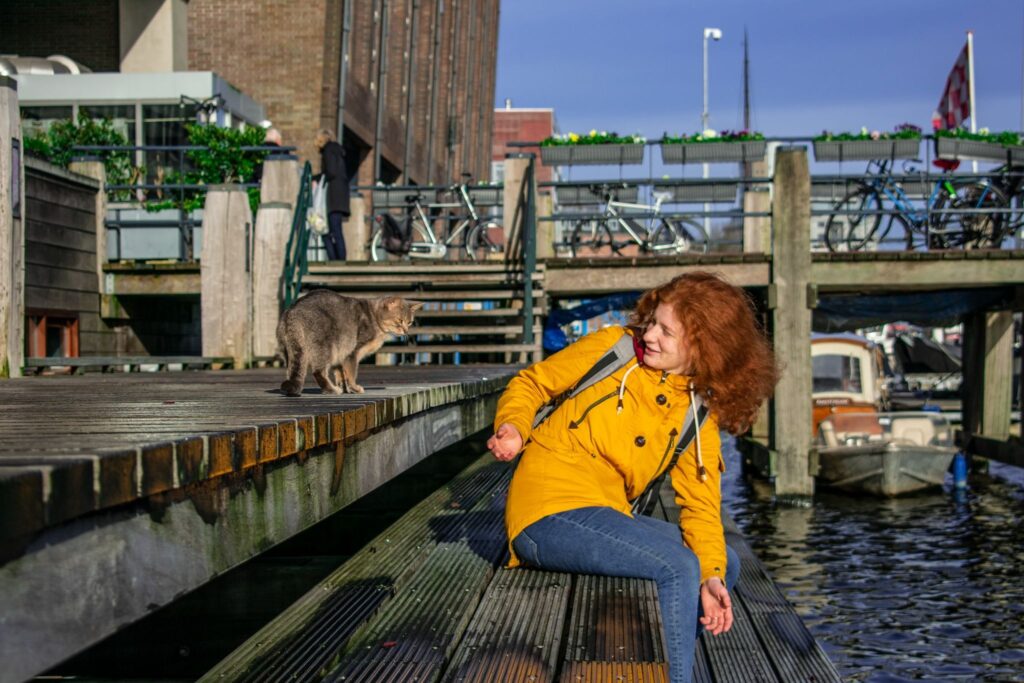
Amsterdam, January 2020. Photo: Vasylyna Borysiuk
Before the full-scale war, the Faculty of Mechanics and Mathematics cooperated with Samsung R&D Institute Ukraine. Around a hundred second- and third-year students did internships there every year, mentored by nearly twenty staff members. Those who performed best were recommended for further internship and employment.
“There was a rigorous selection process with several kinds of interviews,” says Oksana Bezushchak, dean of the faculty. “Since it’s a research center, an employee there needs not just to be able to program, but to have strong mathematical training, algorithmic thinking, and so on. Yulia was the only student in our faculty to make it through. That was very telling for us, though it didn’t surprise anyone. With her potential, Yulia could have built a career in academic research, at a major tech company, or at a leading university. Anywhere she wanted.”
According to Yan Zdanovsky, Yulia did work as a trainee at Samsung for a while. “I once asked her, ‘What exactly are you working on? I’m curious, both as your father and as a professional.’ ‘Dad, NDA.’ That was it,” he recalls. “But in the end Yulia couldn’t reconcile the job with her studies. She knew people who worked full-time somewhere in IT and only showed up at university before exams. She didn’t want that. One day she came and said: ‘No, I’m quitting. If I’m going to study, I want to actually study.’”
At university, too, Yulia fought for fairness.
“During a seminar, a lecturer started shouting at a girl because she didn’t understand him,” Alina recalls. “Yulia called him out into the hallway, told him he needed to calm down and explain again — more slowly and clearly. Because Yulia always listened to him attentively and solved everything quickly, he respected her and listened. When they came back into the room, he explained everything clearly and slowly, and the girl understood him.”
“There was a strong sense that, in her eyes, everyone was truly equal,” adds her friend Vasylyna Borysiuk. “She talked with students and with people in charge more or less on the same level, never trying to pressure anyone and never shrinking in front of someone else’s authority. Everything was to the point, driven by genuine curiosity about people and about the shared work, without any of those looming social conventions. Yulia was altruistic. When someone is genuinely interested in people and takes joy in others’ wellbeing, it shows.”
Yulia had gone to summer math camps since childhood. That’s where Andrii Anikushyn first met her. The “Mudramakitra” school was held somewhere in the woods, so the “classroom” could be pretty much anything.
“Yulia’s group — the youngest kids — met in a wooden gazebo with no walls,” Andrii recalls. “All the chairs stood around the perimeter, and there was a blackboard in one corner. Yulia always sat right up against it — my equivalent of the front desk. And later in school she always sat somewhere up front too. Students often feel shy about saying something to a teacher. If Yulia disagreed with something or didn’t understand it, she said so. Even at that very first session, she was the most active one there.”
When Yulia was 16, it was at that same camp that she first tried teaching herself. As Yan Zdanovsky recalls, the camp director told her: “No, I won’t take you as a student anymore. You’ll be a teaching assistant.”
“At that camp, kids get a huge amount of homework that they’re solving around the clock,” says her friend Alina. “And when they figure something out, they go to any teacher for a check. Kids choose for themselves who to go to. Last year, when they counted which teacher students went to most often, Yulia came in second — even though she was only a tenth-grader.”
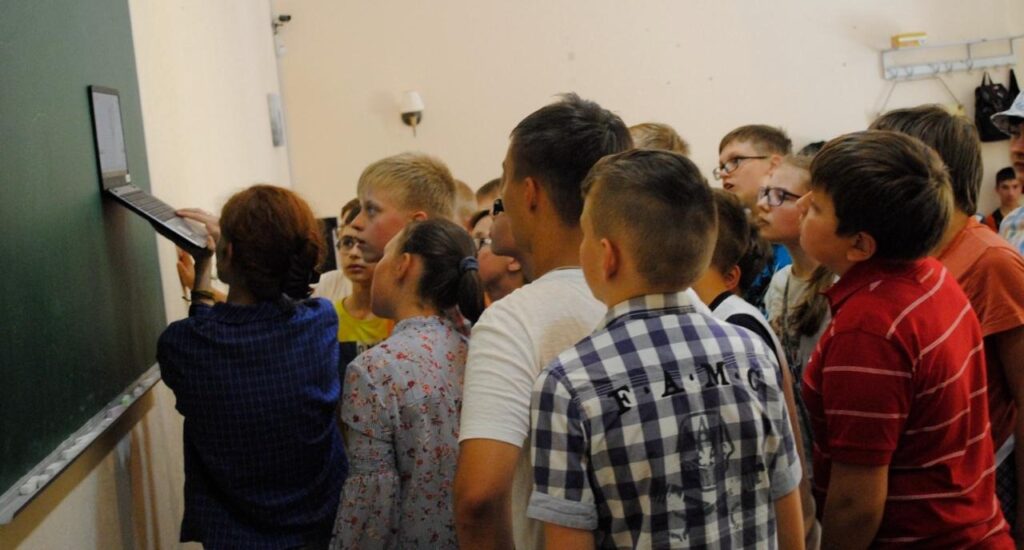
At one session the projector wasn’t working, so Yulia found a workaround and showed the materials on her laptop
“Kvanta” is an educational project that brothers Arsenii and Andrii Nikolaiev launched in 2016 at Shevchenko University. The first year consisted of math classes. The following year, at one of the summer camps, Andrii met Yulia — and when the idea came up to add a programming track to Kvanta, she took charge of it.
“Yulia came to us with this idea back in her first year,” recalls Oksana Bezushchak, dean of the Faculty of Mechanics and Mathematics. “A red-haired girl walked into my office with a backpack on her back and said, almost from the doorway: ‘We want to start a programming club for schoolchildren at the faculty. Will you allow it?’ There was a sense that Yulia’s team really could pull it off, because even then she didn’t just believe it — she knew it would work. It was symbolic: a first-year student who’d only just started her own university education was already thinking about how to build an environment for children. Yulia already understood how to make math and programming not something formal, but something alive, interesting, and engaging.”
Yulia put together the curriculum and taught the first group herself. When the children were invited back the following year, a more advanced program had to be developed.
“That’s how we ended up with three programming levels: ‘Electronics,’ ‘Cyborgs,’ and ‘Terminators,’” comments Andrii Nikolaiev. “Those names have stuck to this day. Some of the students Yulia taught went on to reach the highest level of olympiad programming — the International Olympiad in Informatics.”
Yulia Zdanovska was also involved in recruiting teachers for the club. Among them was Denys Shcherbak.
“Yulia became our lead, and later a friend,” Denys says. “A big part of our relationship revolved around running shared projects — the club, the programming camps. Before Kvanta bought a batch of laptops for kids who didn’t have their own, teachers often lent kids their own laptops for classes, and Yulia was the first to do that.”
Yulia Zdanovska had a genuine gift for teaching. According to Kvanta co-founder Andrii Nikolaiev, it was in the classroom that Yulia truly came alive; her students adored her.
“She was genuinely having fun with the kids,” Vasylyna comments. “A lot of us carry some trauma from teachers who didn’t love the work, who were burned out, or simply weren’t equipped to deal with real, loud, chaotic children. So it was a joy to watch Yulia, who was completely in her element among them.”
Yulia took teaching seriously. Vasylyna remembers that over the course of several years, they had exactly one falling-out — the time she hadn’t prepared materials for their shared programming club.
“Yulia was a bit scattered and forgetful — traits that sometimes come as the price of a talent for math and abstract thinking,” Denys says. “She could forget to eat or sleep, but she always made sure it never affected her students, who were her priority — she’d stay up nights writing tomorrow’s assignments so she could go straight from that to her own morning classes, fueled by energy drinks. Sometimes that pace wore her out, and once everything was done, Yulia might crash for an entire day, falling into something like hibernation before coming out of it and starting the whole cycle again.”
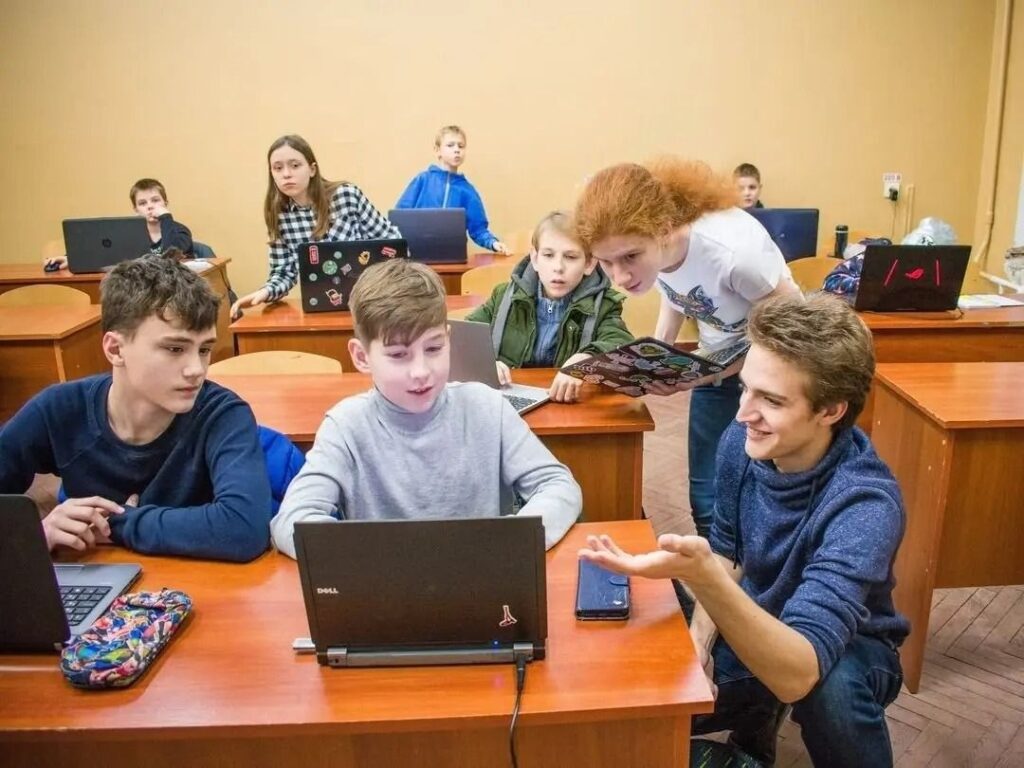
In a class with Denys Shcherbak, 2019
Alina Yan remembers her friend generating tests for a computer science assignment late one night:
“She was so tired she fell asleep in her clothes, laptop still on the bed. Then I heard an unhappy ‘Mmmm! Mmmm!’ I thought she’d woken up and asked, ‘What happened?’ — ‘The tests won’t generate!!!’ I kept asking and got no answer. That’s when I realized she was still asleep, trying to generate tests in her dream.
By the way, Yulia constantly tried little tricks to gauge or boost how engaged the kids were. For instance, in a lecture text she gave out as homework reading, she’d slip in a line: ‘If you’re actually reading this, message Yulia the word “cutlet.”’”
Andrii Nikolaiev recalls that it was telling how many of Yulia’s students didn’t want the lesson to end — and would keep working on problems afterward just to show her the results next time.
“Kids found it easy to be around her, they weren’t afraid to ask questions,” Andrii says. “Yulia became their best friend — they had inside jokes together. At the same time, they respected her because she genuinely knew the material. It was a kind of chemistry: Yulia was instantly their friend, their mentor, and their leader all at once. Her charisma created an atmosphere in the classroom where everyone could be relaxed and engaged at the same time. Yulia was, without question, a born teacher.”
After finishing her bachelor’s degree, Yulia decided not to continue her studies, even though her parents suggested options beyond Kyiv National University.
“One of the universities — either the Kyiv School of Economics or Mohyla — was opening a joint master’s program with a prestigious foreign university,” her father recalls.
Her friend Alina also mentions that Yulia traveled to Norway to work on mathematical ideas with Professor Andrii Bondarenko. But none of these opportunities appealed to her.
In 2021, Yulia applied to a program run by Teach For Ukraine. Its Fellowship participants relocate for one to two years to a village or small town and work as teachers.
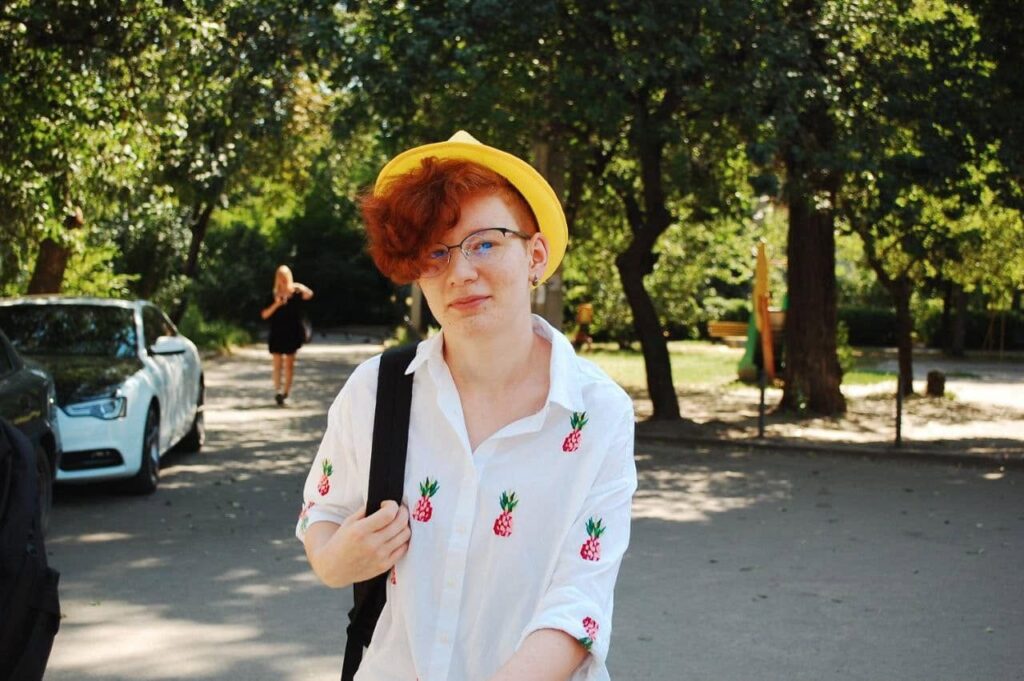
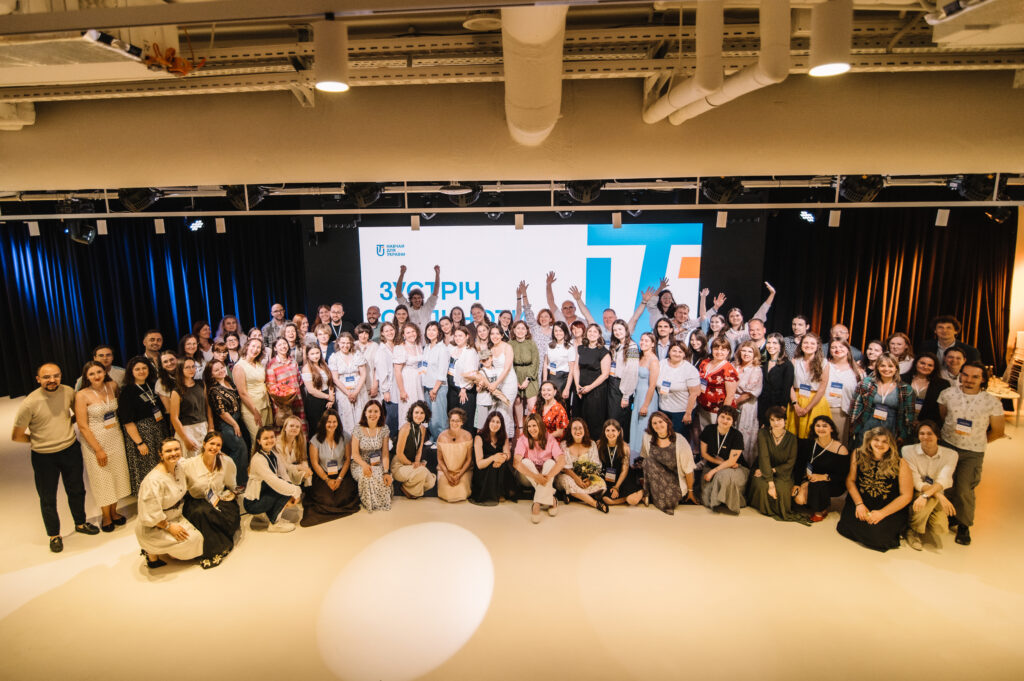
Orientation at Teach For Ukraine
In her motivation letter, Yulia wrote that she had always wanted to become a teacher, ever since her own school days — and specifically in a small town or village.
“…children in big cities have plenty of opportunities: clubs, tutors, specialized schools and lyceums of every kind. In a small town or village, there are far fewer such opportunities. That’s why what I can offer them — say, an interesting programming club — will matter more and be more useful.” From Yulia Zdanovska’s motivation letter for the Teach For Ukraine Fellowship.
According to the Teach For Ukraine team, during the later stages of selection Yulia showed herself to be a proactive, detail-oriented, and confident candidate. They noted her natural rapport with an audience and her ability to hold a classroom’s attention:
“She spoke dynamically, with a lively, pleasant tone that conveyed her enthusiasm for the subject. What stood out most was how she responded to every single student, drew them into the work, and pulled their attention back with interesting questions.”
Yulia was assigned to teach math and computer science in the village of Yurivka, Dnipropetrovsk region. The school’s principal recalls that the new teacher arrived two weeks earlier than necessary.
“She got to know her classroom, checked every computer, and made a list of what needed to be replaced or repaired. She personally took on the internet situation, tested the signal in every classroom, and basically fixed connectivity in every corner of the school,” the Teach For Ukraine team recalls.
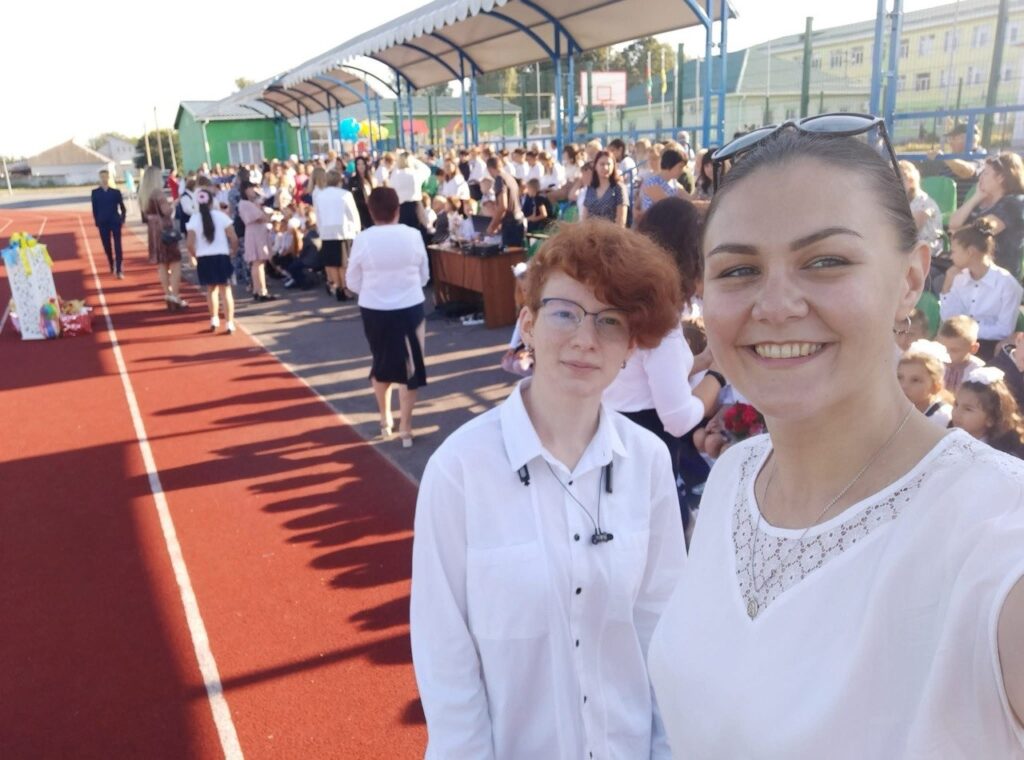
September 1 at Yurivka school, with colleague Adriana
Of course, not everything went smoothly — there was plenty of difficulty. Yulia’s father recalls one such episode:
“New computers were delivered to the computer science classroom. My daughter goes to turn them on, and there’s no operating system installed. Management sent her to some technical support department at the regional education office. Yulia calls, and they say: ‘And who are you?’ — ‘The computer science teacher.’ — ‘That’s not the right level. Have your principal call me, or at least your deputy principal, and I’ll explain how to file a request.’ That infuriated her to no end.”
Despite every obstacle, Yulia managed to accomplish a great deal in a little over half a year. Within a month she had already suggested the teachers switch to Google Classroom for remote lessons, helped everyone set up online classrooms, and taught them how to use them.
“Together with another Fellowship participant, Adriana, they ran a coin drive collecting old 25-kopeck coins that had gone out of circulation but were still accepted by the bank. They donated the money they raised to children with cancer. They also entered the school in a competition that won it a set of plastic containers for sorting waste,” the Teach For Ukraine team recalls.
At one staff meeting, it came out that many students were coming to school hungry. Yulia found sponsors willing to pay for lunches for children who couldn’t afford to buy food themselves. After she was gone, colleagues found about a dozen headphones in her desk that she’d bought with her own money so students could use them for schoolwork.
“She gave one boy her old phone because he had nothing at all to study remotely with, and bought herself a new one,” Yan Zdanovsky recalls. “The school she was assigned to had been nicely renovated under some grant. There was a ping-pong table, but it just sat there unused. Yulia bought paddles, balls, and a net with her own money. It came as a shock to the students that she sometimes played with them herself.”
Yulia ran a math club and dreamed of setting up a full robotics classroom at the school.
“She taught herself to use a 3D printer, worked through different printing schemes, and waited eagerly for every new piece of equipment. The last shipment arrived a week and a half before February 24, 2022,” the Teach For Ukraine team recalls.
Although Yulia had lived away from home since age 14, she visited her family in Kharkiv fairly often. That was the case during her school break from Yurivka in February 2022. Her sister Olha recalls a conversation about something that had been weighing on Yulia:
“She had a student, an excellent student, so afraid of her parents that she was engaging in self-harm. When Yulia went to the school administration about it, she was told: ‘Her parents work, they don’t drink — there’s no need to get involved in anything else.’ The issue was never resolved.”
Yulia was staying at home for a few days when the full-scale invasion began.
“You chose the most peaceful profession on earth — school teacher. And when the war started, for two days you literally paced around the house, because you wanted to defend your country and your native Kharkiv. But that, I think, is the one thing you never learned how to do — use a weapon.” From a post by Olena Vynnyk, Yulia’s mother
Her parents urged their daughter to go back to Yurivka, where it was safer. To friends who suggested she leave, she replied: “Thank you, but I’m staying in Kharkiv until victory.”
Yulia’s whole family volunteered. She herself had already been helping for years — since 2015 she had helped organize holiday events for displaced children and taught math at the “Station Kharkiv” foundation.
“In the first days of the full-scale war, everyone in the family was trying to figure out what was happening and who to join,” her sister Olha recalls. “We mostly started helping civilians, while Yulia had this conviction that the first priority was to help the military.”
“…on the third day of the war you saw an announcement that the Kharkiv region’s defense headquarters needed not just soldiers but volunteers too. As always, trying to influence your decision made no sense whatsoever.” From a post by Olena Vynnyk, Yulia’s mother
Public transport wasn’t running, so Yulia walked to the city center on foot. For the first few days she came back to her parents’ place to sleep. On February 28, volunteers were given a choice: go home and stop coming, or stay at headquarters around the clock. Yulia chose to stay.
“I asked her, ‘Have you really thought this through?’ — ‘I have.’ There were a few attempts to offer her other kinds of volunteer work. But to all of them she’d answer something like, ‘Oh, let me suggest some people I know,’ or ‘I’ll look for someone who can take that on,’” Yan Zdanovsky recalls.
On March 1, 2022, two Russian missiles struck the center of Kharkiv, hitting the regional administration building where the defense headquarters was based. According to prosecutors, 31 people were killed that day.
Yulia’s father recalls that just a few minutes after the explosion, his daughter wrote: “I’m fine.”
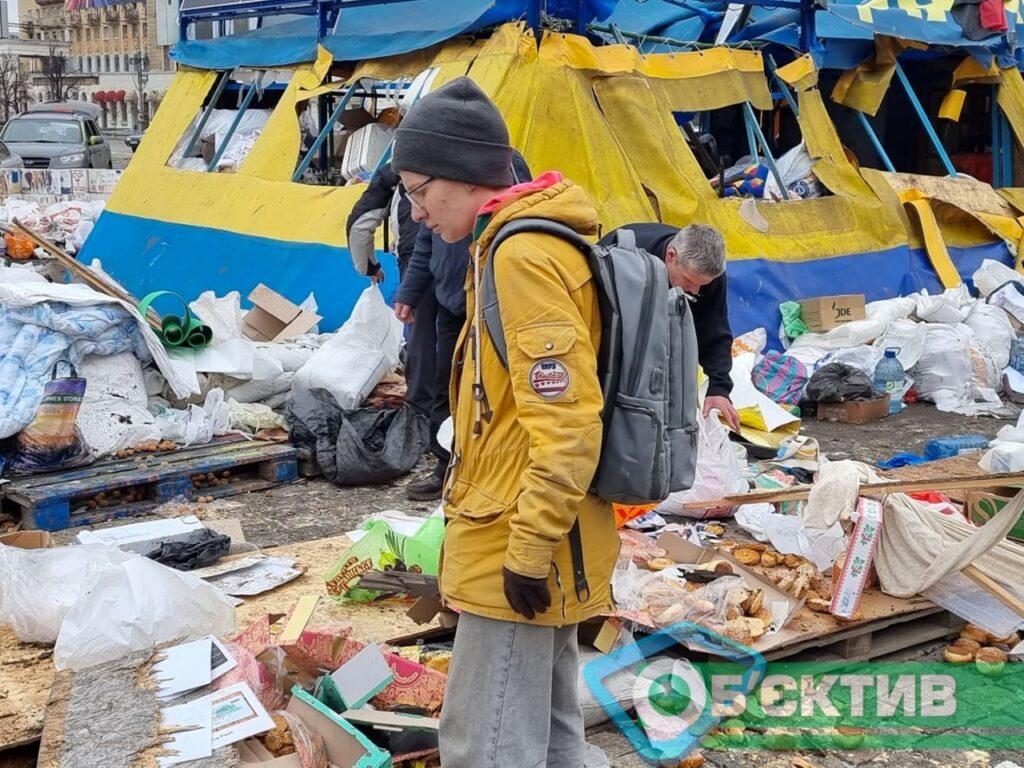
Yulia near the Kharkiv Regional State Administration building after the March 1 shelling. Source
“She kept telling us that civilian volunteers were based at the regional administration alongside her — and that ‘the ones with weapons’ were supposedly a separate group,” says Yan Zdanovsky. “Some of those people later became part of the ‘Kraken’ unit. After Yulia was gone, one of her friends showed us their correspondence. It turned out there was a waiting list among the civilian volunteers to join the armed resistance. After that first missile strike, her friend wrote to her: ‘Listen, this is getting really dangerous! Maybe you should leave after all? Go volunteer somewhere else?’ And Yulia answered: ‘You don’t understand anything! After that strike, a lot of people left. And because of that I moved way up the list for getting a weapon. Why would I leave now, with odds like that?’”
In those days, Yulia would always make sure to write to her family in the morning, and again in the evening if she could, since they spent nights in a basement where there might be no signal.
On March 3, at 18:41, she wrote to a friend that everything was great and she was volunteering. At 18:43, a powerful explosion rang out across the city.
“Even though it happened fairly far away, our house shook from it. And I texted my daughter on Telegram, ‘ping’… Usually, when she saw it, she’d reply ‘pong.’ That ‘ping’ ended up being the last message,” Yulia’s father recalls.
Information that it had been a missile strike wasn’t published anywhere at first. Only later did it become clear that a missile had detonated right next to the regional administration building. The family didn’t panic through the next day, since they were waiting for Yulia’s usual morning message.
“On March 4, my husband came to pick up my father and me, saying we were going to drive a foreign journalist around,” her sister Olha recalls. “By that point we already had a territorial defense unit we knew, who agreed to show him around, but he needed a translator. While we were out doing that, my parents kept trying to reach the headquarters coordinators Yulia had been assigned to. Around three or four in the afternoon we realized we needed to go to the site ourselves. When I heard about the missile strike, I understood Yulia was gone. I had no hope we’d find her alive. My parents kept hoping — right up to the last minute.”
The next day, Yulia’s backpack was found in the building where the volunteers had been sleeping at night.
“After that there was basically no hope left,” Yan Zdanovsky says. “But the whole time, headquarters had no information about where the bodies of the dead had been taken. I understand now that our daughter could just as easily have ended up in that trench” — in 2022, a mass burial site of more than 1,000 people was discovered at Kharkiv’s 18th cemetery, ed. — “if not for an acquaintance who somehow, by some miracle, found contacts at the morgue. She called us the next day and said there was an unidentified body with a distinctive ring.”
On March 7, Yulia’s family identified her from photographs.
“What matters is that on March 15 we were able to bring Yulia home. What I saw that day was simply hell. Morgue staff would spend ten minutes wandering the yard looking for the right body, moving bags from place to place, while relatives waited,” Yan says.
According to Yulia’s mother, Olena Vynnyk, they would like the memory of all the volunteers who died on March 3 to be honored. So far, only seven of roughly ten names have been established.
She didn’t want Harvard — she wanted to be Ukraine’s Minister of EducationWhen someone, at her graduation, wished Yulia a future as a Harvard professor, she replied: “I don’t want to be a professor and I don’t want to go to Harvard — but I would gladly become Ukraine’s Minister of Education.” In an interview shortly before she left for Yurivka, she said she wanted to contribute to change on a global level.
“…I see systemic problems in Ukrainian school education. (…) But to solve the problems of Ukrainian schools, you first need to really understand them, to picture what a school looks like ‘from the inside,’ what difficulties teachers actually face in their work. And the best way to do that is to work in a school for a few years.” From Yulia Zdanovska’s motivation letter for the Teach For Ukraine Fellowship
In life, Yulia had a gift for bringing people along with her. The force and brightness of her personality continue to inspire people today.
Four months after Yulia’s death, Ukrainian mathematician Maryna Viazovska received the Fields Medal. In her acceptance speech, she mentioned Yulia Zdanovska, describing her as someone full of light whose great dream had been to teach mathematics to children in Ukraine.
In Yulia’s memory, the Massachusetts Institute of Technology established the educational project Yulia’s Dream for talented Ukrainian high schoolers, and the Jagiellonian University established a scholarship for students in its Faculty of Mathematics and Computer Science. An olympiad for grades 5–7 now bears Yulia Zdanovska’s name in Ukraine.
Since 2022, there has been a Yulia Zdanovska Street in Kyiv (formerly Lomonosova Street).
“It’s the very street they used to run down from the lyceum for snacks, and where the Kyiv National University dormitory is located. Yulia walked that street for seven years — a third of her life. Now new generations of university students walk it,” adds Olena Vynnyk.
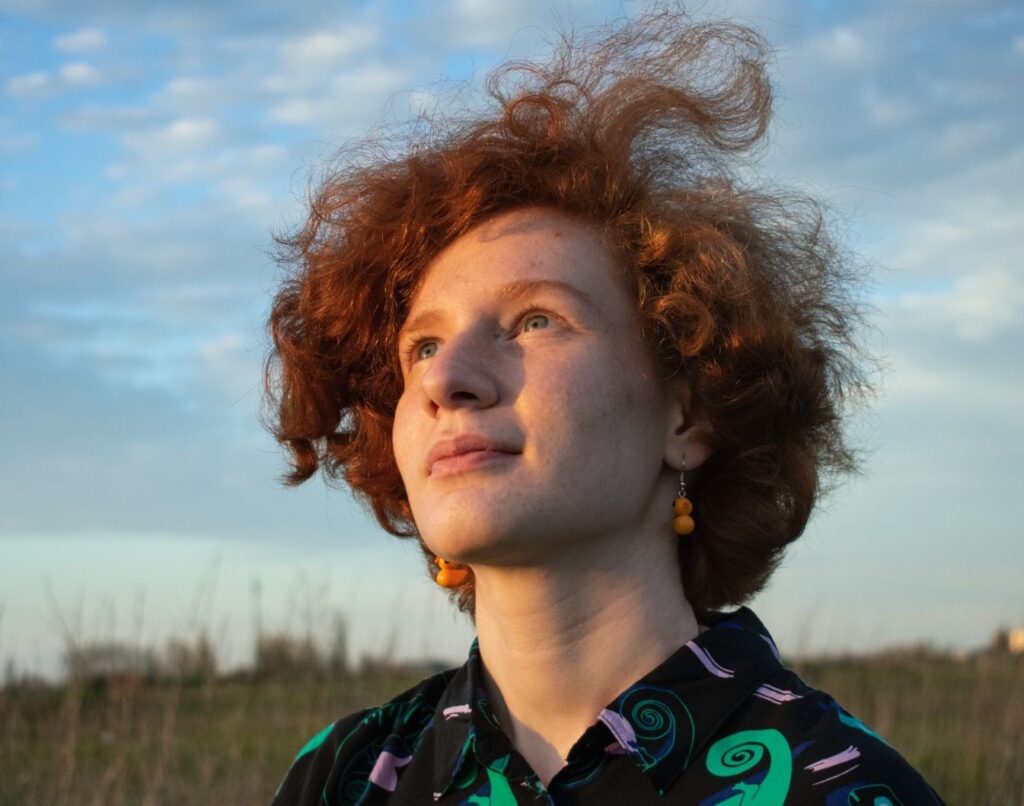
Photo: Vasylyna Borysiuk
“I wasn’t even surprised by Yulia’s idea to go volunteer at the Kharkiv Regional State Administration. I didn’t try to talk her out of it, because Ukrainian resistance, especially back then, rested on people who fearlessly went and simply did what needed doing. I think we both understood she was one of those people, and that trying to stop her would have been counterproductive. In general, I’m afraid of too many things — she was afraid of too few, and she was the only person I constantly begged to get down from somewhere, because I was physically scared for her. And she never did get down.” — Vasylyna Borysiuk, friend and colleague
“She was someone who fought for fairness, who changed the world step by step, constantly. It’s hard to put into words — you had to see her energy with your own eyes, in every specific instance. How she carried heavy things up the stairs for elderly women in the underpass. How she’d spontaneously stay after class for hours because a classmate she’d never spoken to before said, ‘I don’t understand how to program in Python.’” — Alina Yan, friend
“Yulia was extraordinarily kind, sensitive, and caring. Always ready for an adventure, with a great, if slightly odd, sense of humor.
My brightest memory of her is a tradition among the Kvanta teachers — walking to a nearby playground in the evening after class, buying ice cream, and talking about everything under the sun while sitting on the edges of the sandbox. The programming section Yulia built from scratch, she eventually handed over to me. The curriculum changes, of course, but at its core — especially for the youngest groups — the assignments are still all ones she came up with. I believe that one day her friends, colleagues, and students will be the ones to carry her dreams into reality.” — Denys Shcherbak, friend and colleague
“Yulia was a luminous, remarkably honest, and vivid person — she radiated energy. Behind her openness stood real principle, depth, and a genuine sense of responsibility that went well beyond her years.
It’s very hard to talk about Yulia in the past tense. Because when you remember her, you think not only of the loss, but of the scale of the future that might have been. She could have become a strong researcher or programmer. Instead she chose the path of an organizer of educational change. She was like a little sun — red-haired, bright, inspiring. Her death is an unspeakable pain for us.
The best thing we can do today is keep doing the things that mattered to her: supporting talented young people, developing math education, giving children from different cities and villages a chance at a strong education, protecting honesty and freedom. That’s the Ukraine Yulia lived for. And that’s the Ukraine she wanted to see.” — Oksana Bezushchak, dean of the Faculty of Mechanics and Mathematics, Kyiv National University
“The world sees her as a mathematician, but I see her as a person. To me, mathematics was just one part of her. If we’re talking about the bigger picture, I think what mattered most was her drive for change itself. It could have been math, physics, the Ukrainian language — it wouldn’t have mattered.
I personally admired her — I saw in her an example of the generation we’d been waiting for: modern, brave, ready to fight for their rights. They were the first to join the Defense Forces, and some of them died. But many stayed on, and I believe this generation has the strength, the drive, and the understanding of how to push this world in the right direction.” — Olha Vynnyk, sister
“You had everything: boundless sincerity and a soul of extraordinary depth, pieces of which you generously handed out to everyone around you. A mind that I honestly found a little intimidating, because I only ever understood maybe a third of what you were telling me when you talked about what you were studying and the math problems you were solving. And just plain girlish beauty. (…) Your life was short and bright. I’m certain that flash of light will keep shining for many people still.” — Olena Vynnyk, Yulia’s mother
On May 4, 2026, Yulia’s mother wrote on Facebook:
“…Your magnolia is blooming again… But you won’t make a wish, and you won’t blow out the 26 candles on the cake the way you should. Happy birthday, our golden, red-haired little sun, Yulia.”