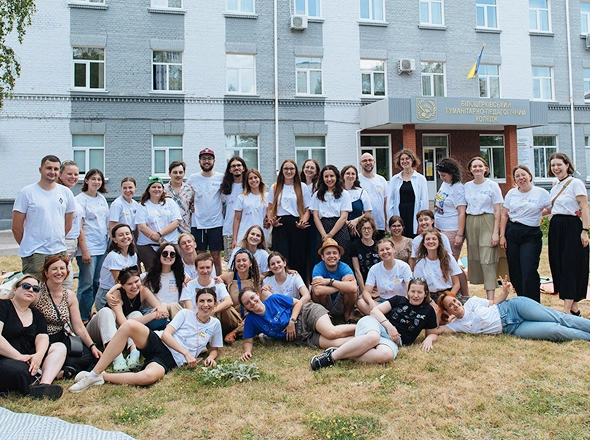
The 3.5 million children born during the 12 years of Russia’s war against Ukraine represent a generation with a unique and complex experience, one that has no time to wait for global crises to end. These children are fundamentally changing the demands placed on education: a modern school must work proactively, teaching resilience, critical thinking, and the ability to drive change in conditions of uncertainty.
At the same time, Ukraine, like the rest of the world, is experiencing an unprecedented educational crisis: the gap between academic knowledge and labor market requirements, staff shortages, low student motivation, rapid technological progress, and the consequences of the COVID-19 pandemic. The war deepens and complicates each of these challenges. Therefore, the experience of resilience and leadership necessary for the country’s recovery depends on who stands before the children in the classroom today.
The mission of Teach For Ukraine is to develop the next generations of leaders through quality education for the recovery and sustainable development of Ukraine. One of the main instruments of change is the Teach For Ukraine Fellowship—a leadership development program through teaching, thanks to which specialists from various fields and university graduates become teachers in small communities for one to two years. Educational leaders learn to manage change, make decisions under uncertainty, and directly influence the future of communities.
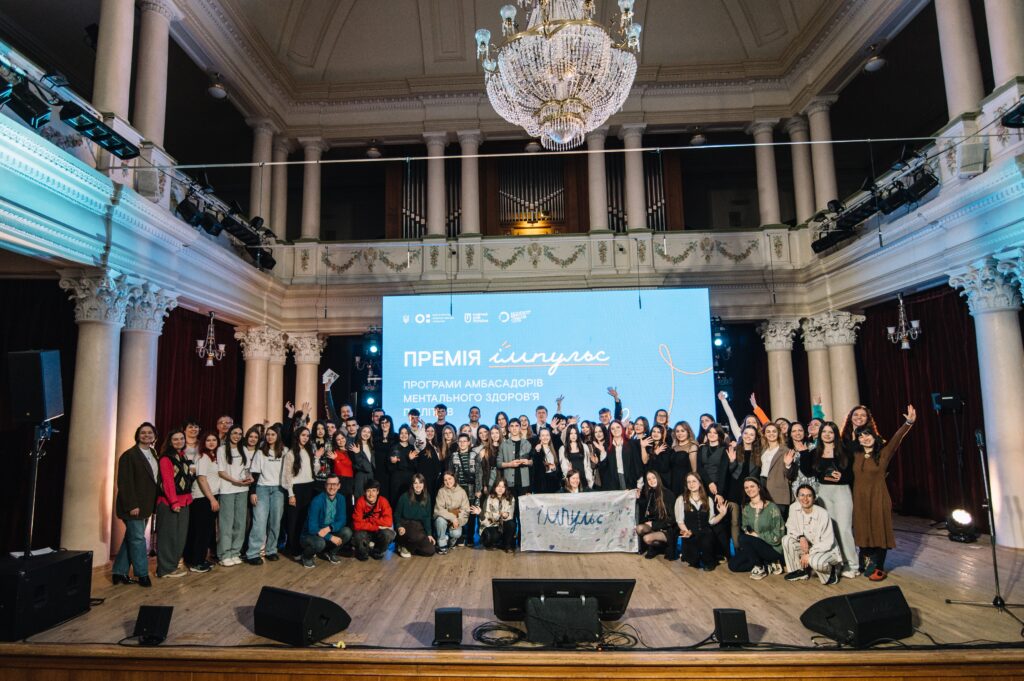
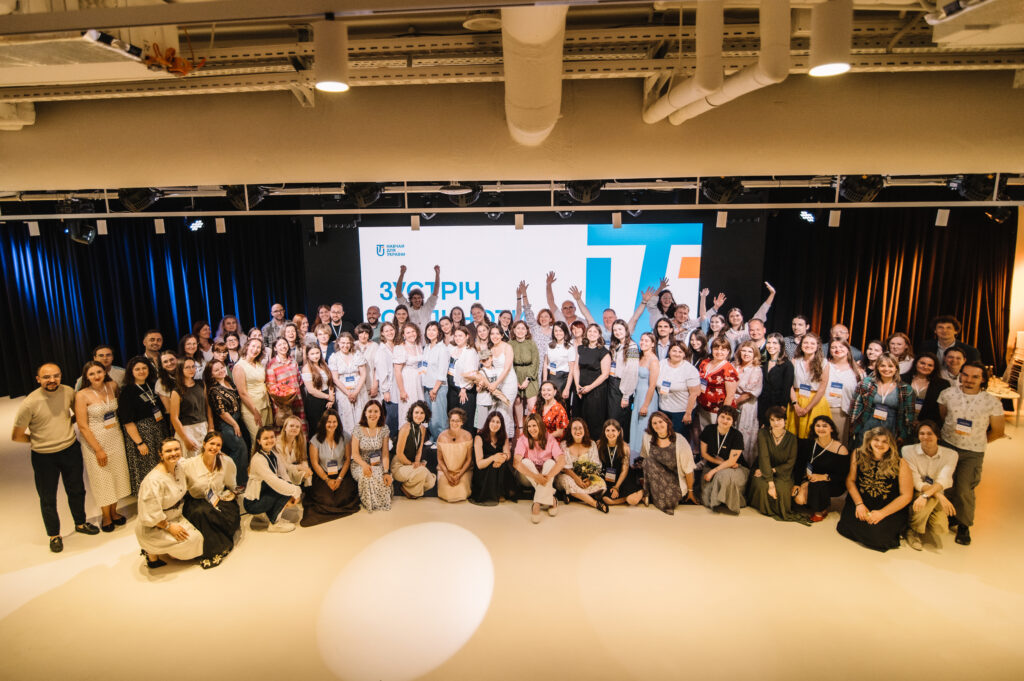
On June 25, those who consciously chose the path of the Teach For Ukraine Fellowship met in Kyiv. We have gathered the most important takeaways from this meeting—about leadership, equity, and education that is not afraid of change.
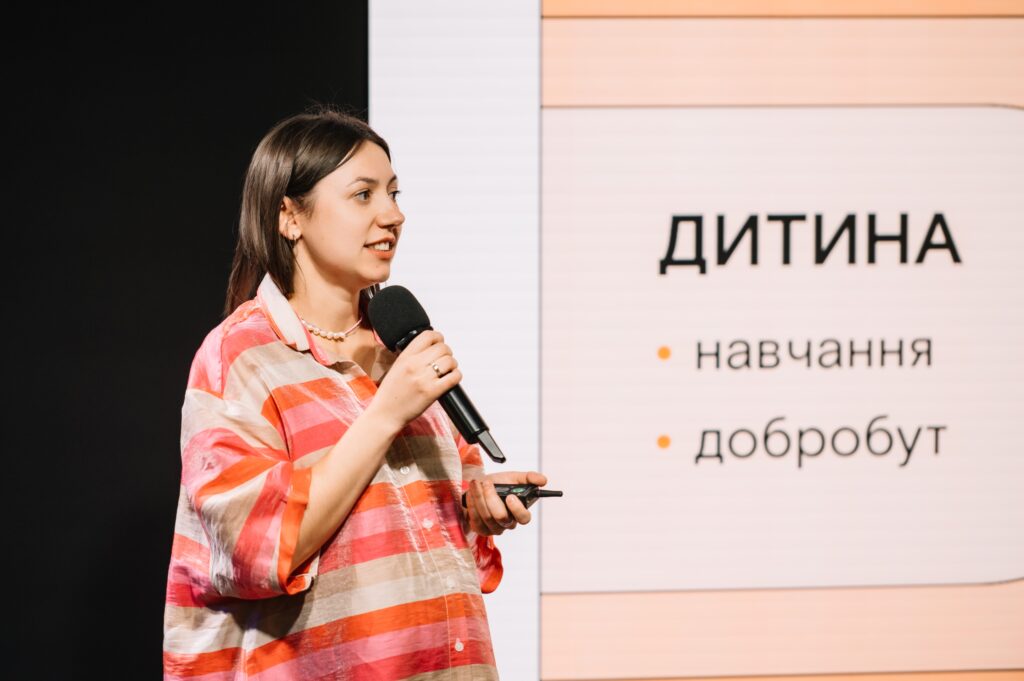
The event was opened by Inna Rakhmistriuk, Head of the Teach For Ukraine Fellowship. In her speech, she called on those present to fully embrace every word of gratitude coming from students and colleagues.

“Despite everything happening in our lives right now, despite all the hardships and challenges, it is incredibly valuable to share these celebratory moments together here, in this warm circle. Everything we do is ultimately for the children. Not just for words of gratitude, but for what happens next, for who these children grow up to be. And perhaps, one day, they will appear here with us not as students, but as program participants or members of our team. We already have such stories,” Inna noted.
She emphasized that the organization’s mission remains unchanged: we work to ensure that every child in Ukraine can fulfill their potential, regardless of their place of birth or residence. Today, this work scales across several interconnected levels: directly with students, through supporting teachers and building community capacity, in cooperation with educational leaders in partner schools, as well as at the systemic level—by expanding cooperation with the Ministry of Education and Science of Ukraine.
Throughout the year, participants of the Teach For Ukraine Fellowship worked in 20 partner schools across four regions of Ukraine. This year, the geography of the program expanded: educational institutions from the Poltava region joined for the first time.
The academic year was successfully completed by 28 participants of the first and second years of the program, and 14 of them became this year’s graduates. The rest continued their journey in the program. The daily work of teachers in classrooms reached over 5,000 students. In addition to lessons, more than 20 projects were implemented together with the children, the results of which were presented at a special exhibition during the event.
Learning recovery sessions, attended by more than 800 students, were also an important component.
As Inna Rakhmistriuk pointed out, their success is measured not only by academic indicators, but primarily by the change in the child’s inner state and the building of trust in the classroom:
“It’s not just about ‘now I know and can do this, and look how my grade grew between the beginning of these classes and the end,’ but also about the feedback from students who say: ‘Now I’m not afraid to make a mistake, I’m ready to ask the teacher what to do when I don’t know.'”
In addition to the cohort’s achievements, the Head of the Teach For Ukraine Fellowship emphasized the critical importance of cooperation:
“Every idea born in our team’s mind goes through many iterations and stages to gain support and confirm its importance. And when our partners respond to new ideas or projects, it is always extremely valuable.”
The program continues to support alumni after they complete their participation—last summer, seven of them implemented their own educational initiatives with the support of the organization.

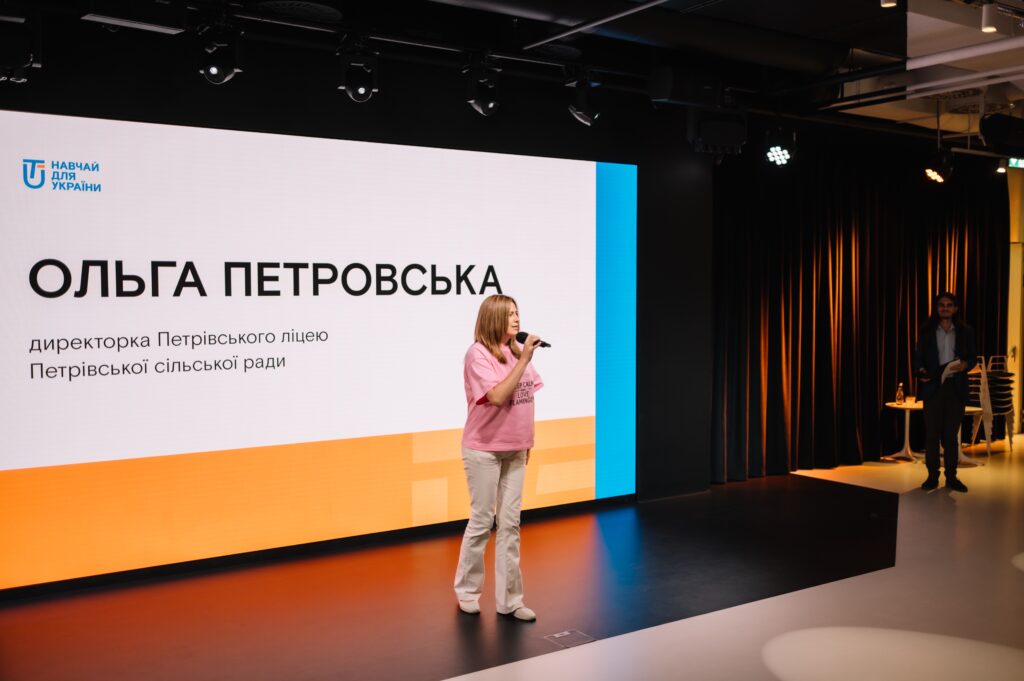
Olha Petrovska, Principal of the Petrivske Lyceum of the Petrivske Village Council, spoke on behalf of the partner educational institutions. Olha Viktorivna began with reflections on the choice that every educator makes every day since the beginning of the full-scale war:
“We do not choose the time we live in; we choose who to be in this time. Recently, I heard a phrase: ‘I wish for you to find your people in this life.’ For me, it became the accumulation of all events. I understand why we are all here. We are united by one important shared mission.”
In 2023, when there was a catastrophic shortage of teachers and the lyceum was resuming cooperation with the Teach For Ukraine Fellowship, Olha Petrovska was worried about which participants would come:
“And then such awesome people came! People with brilliant prospects. And then these people stayed with us to teach after completing the program. In 2024, I applied again. And 2024 is a bunch of challenges. You can’t plan, you can’t always think constructively because you haven’t slept all night… And you have to come and be a pillar of support for others. And once again, wonderful people come to us! That is why now, in 2026 and 2027, I will apply with confidence that the Teach For Ukraine team will select the best. And these participants will be a source of inspiration for our children and for our teachers.”
Addressing the graduates and program participants directly, Ms. Olha gratefully emphasized the long-term value of their daily work:
“Sometimes we are afraid to admit to ourselves that our contribution is actually very important. Someday, in 10 or maybe 15 years, when we look at a new generation of politicians, scientists, doctors, and new teachers, we will be able to say with pride: ‘This is my school.'”
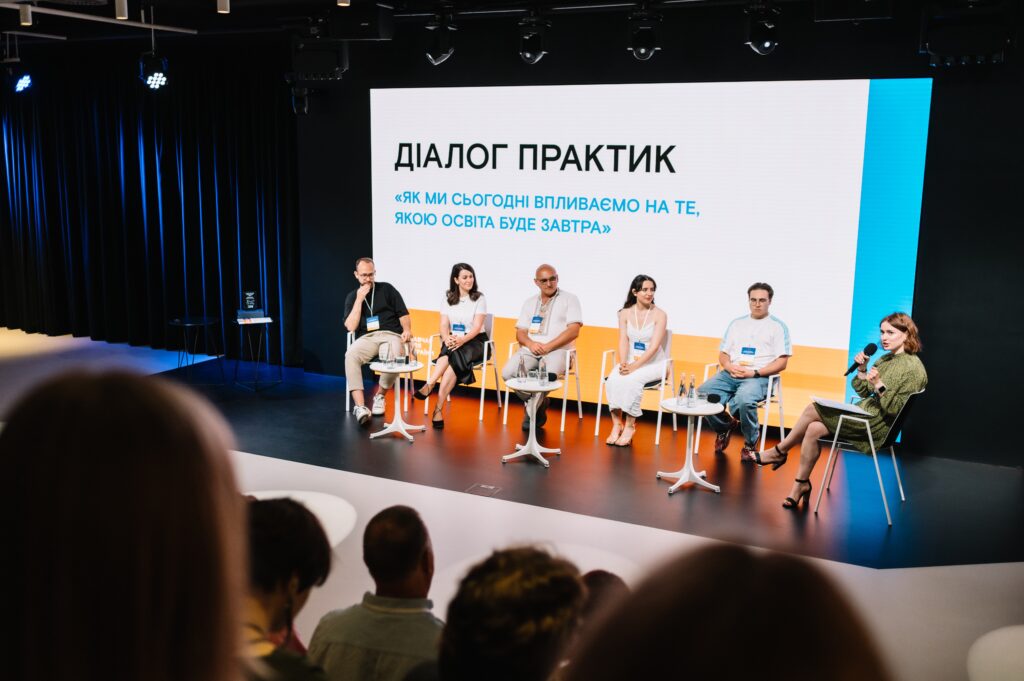
One of the central events of the gathering was a panel discussion that brought together representatives from various levels of Ukraine’s educational ecosystem—from students to administrators. The discussion was moderated by Alina Opriatova, Recruitment Manager for the Teach For Ukraine Fellowship.
The participants shared their insights on the opportunities to influence education from different perspectives.
Yelyzaveta Shelestova, an alumna of the Teach For Ukraine Fellowship, entered the program and the educational field after graduating from the Faculty of International Relations at Taras Shevchenko National University of Kyiv. She used to have global ambitions, believing that all problems could be solved through conventions and high-level agreements. However, working at a school quickly changed this lens.
“I come to school, and I don’t see conventions, treaties, or presidents. I see students, colleagues, and fellow villagers. My main insight was this: I realized that change begins with people, not with large, unnamed processes. And it starts from the bottom up, not from the top down. When you listen to your students and understand their needs, you can achieve truly great things.”
For Artem Chernenko, Yelyzaveta’s student from the “Lider” Lyceum in Piskivka, the arrival of young teachers became a catalyst for the development of student self-governance. Supported by the program, the students successfully organized a large-scale career guidance forum, inviting top professionals from various industries.
“We organized a talent show and a debate club. But most importantly, I realized that you can introduce and come up with almost anything you want here, and sooner or later, it can be brought to life. This shows that we, as students, can influence the development of our environment.”
Vitalii Kostiuk, Principal of the Piadyky Lyceum, emphasized that a young teacher cannot fulfill their potential without the support of the administration. The principal’s role is not only to find a specialist but also to create comfortable conditions and a space for action.
“The staff is often inert, and young people are initially received with caution. Therefore, support is key… It is very gratifying when those who have been with us want to return. We wish all participants that the schools you entered become places you want to return to.”
Iryna Romanenko, Director of the “MriiDii” Educational Center, highlighted that in times of crisis, partnership for schools is no longer just an optional extra, but a necessary condition for development.
“We noticed a pattern: the greatest success happens where the school is open, where it is not afraid of change, and where it trusts. Where it can abandon something standard and try something new. For us, partnership is about shared responsibility. And shared responsibility means quality education.”
At the systemic level, these changes are supported by the state. Vladyslav Shtegelskyi, Project Manager at the New Ukrainian School (NUS) Implementation Office under the Ministry of Education and Science of Ukraine, spoke about the importance of trusting teachers and creating tools (such as the “Vector” platform) that provide educators with a real choice in their professional development.
“It is incredibly valuable when the state supports solutions born within the civil society sector, and the civil society sector creates initiatives capable of real scaling across the entire country. The core philosophy of the state today is that it trusts the teacher. Who should be the first to evaluate the quality of learning and new educational products? The teacher. Today, they have a truly great freedom of choice, but it comes hand in hand with immense responsibility. That is why today we speak about a paradigm of trust—where the state supports community initiatives, secures this freedom of choice, and gives the teacher real tools for growth.”
Concluding the discussion, the participants agreed that the education of the future is impossible without joining forces, where everyone at their own level takes responsibility for the common result.
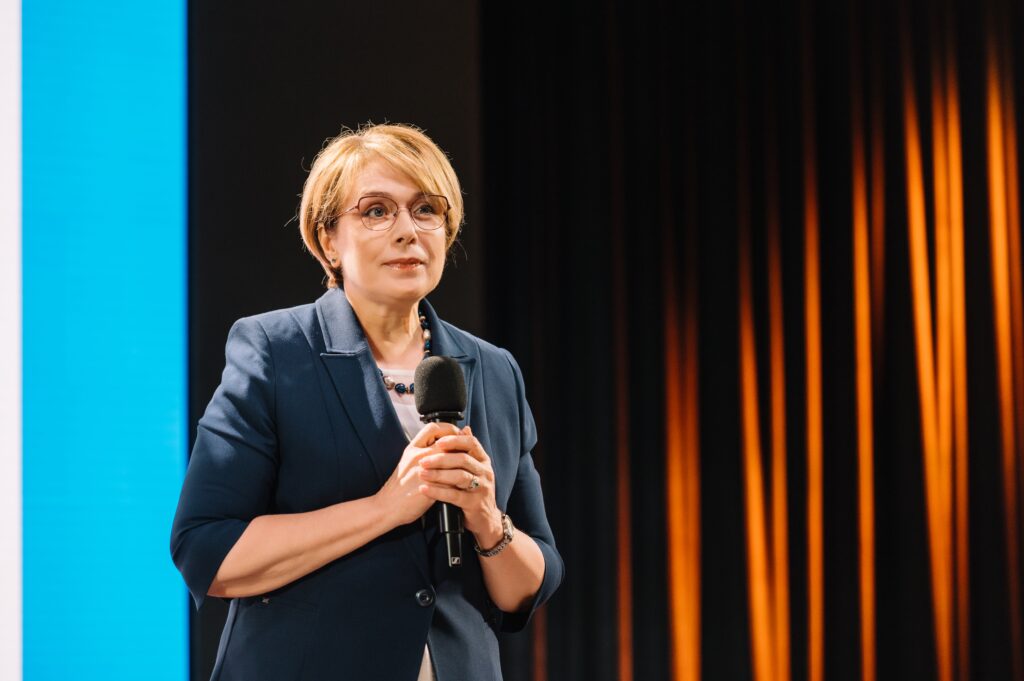
Liliia Hrynevych—Vice-Rector for Research and Pedagogical Work at V. N. Karazin Kharkiv National University, and Minister of Education and Science of Ukraine in 2016–2019, who supports the work of “Teach For Ukraine” year after year—addressed the community.
This time, Ms. Liliia spoke to the graduates not only as an expert but as someone whose own path into education was completely unexpected.
The educator admitted that she once dreamed of becoming a biochemist and creating medicine. However, life circumstances forced her to take a job at a school as an after-school care group teacher. It was there, amidst the daily challenges and joys of children, that she realized education was her true calling—her srodna pratsia (genial work).
Liliia Hrynevych highlighted the unique value of the experience of the program participants who come to schools from different professions:
“When you work in a school, directly with children, with colleagues, and with all those challenges—it gives you a completely different lens through which you look at various events later on. I am amazed by your action, because it is a choice—having a degree in a completely different field, to make the decision to come to a school.”
The expert shared how immersing oneself in school life helps identify real problems and sparks global reforms. Recalling her experience managing a school in the late 1990s, she shared a story about a talented honor graduate who failed to enter a journalism program due to bribery. It was the pain of witnessing the fate of her own students that drove Liliia Hrynevych to seek a solution, which eventually led to the creation of the External Independent Testing (EIT/ZNO) system in Ukraine.
“Some of you will continue to work in schools, some elsewhere. Fate may lead you through different levels of management. But do not forget about these injustices and the opportunities for improvement that exist today. Because from any position, a person can influence education.”
In conclusion, Liliia Hrynevych thanked the Teach For Ukraine team and all the graduates for their servant leadership. She reminded them that even the best ideas (such as the concept of the New Ukrainian School, which was born during discussions on the Maidan) become reality only when the whole society unites—both those who know the system from the inside and those who bring a fresh perspective from the outside.
“I wish for you to understand and remember that belonging to a community is an immense value. But any value, just like love in a family or relationships between people, needs to be nurtured. And this nurturing happens from both sides. So, I wish you inspiration and a constant inner restlessness that will help you develop and create something new.”
According to a fine tradition, an alumnus or alumna takes the floor on behalf of the cohort at the community meeting. This year, the opportunity to deliver the speech was given to program graduate Nataliia Demchuk.
Two years ago, she came to teach Ukrainian language and literature at the Holovuriv Lyceum in the Kyiv region, bringing with her a background in journalism—a habit of asking questions, summarizing, and focusing on details.
“I knew I would learn a lot, but I didn’t think it would be this much,” Nataliia admitted, addressing the audience. “I realized that a classroom of 15 children means 15 worlds to which you need to find a key. I learned that an extracurricular project will be successful only when the children themselves want to tell their own story, rather than just complete an assignment.”
The greatest insight of these two years for the alumna was the realization that all school subjects are actually just tools to achieve one grand goal:
“While philologists looked for meanings in the classics, historians taught children to understand the context of their time. English teachers gave them a voice on the global stage. And STEM teachers showed how something much larger appears and grows. We studied different things, but the goal was shared—to teach children to think freely and independently.”
Addressing the graduates, Nataliia reminded them that these two years were filled with valuable experience, but also with fatigue, air raid alerts, and difficult compromises with circumstances that sometimes turned out to be stronger. Nataliia mentioned those who, for various reasons, could not cross the finish line of the program, emphasizing that the cohort includes not only those holding diplomas today, but everyone who shared their first difficulties and discoveries.
“We succeeded not because each of us pulled through this journey alone, but because we went through it together,” she emphasized.
Finally, Nataliia recalled the shared values that united the graduates from the very beginning:
“If there is something I want to leave behind, it is not a guidebook or a lesson plan. It is the conviction that every child in Ukraine must have the opportunity to fulfill their potential, regardless of their place of birth or residence. Two years in the communities have left us all with confidence: we know how to overcome difficulties. And we must do it together.”

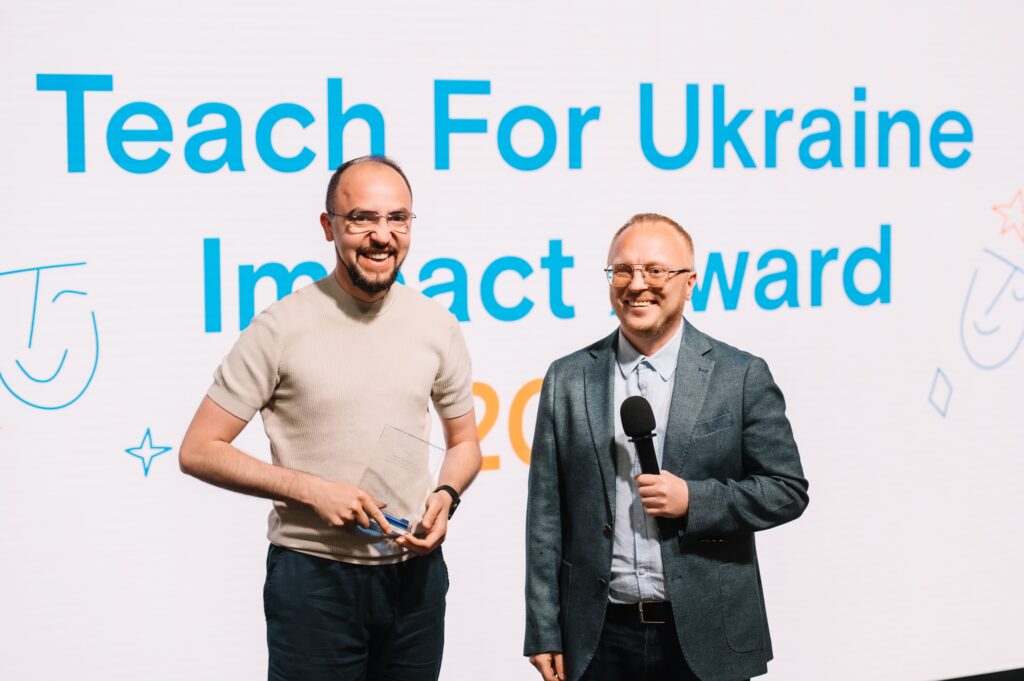
The closing event of the meeting was the presentation of the TFU Impact Award—an accolade for graduates whose initiatives contribute to change and overcoming educational inequality. This year, Yaropolk Tymkiv, Program Director of the “Mnozhyna” Foundation, was invited to present the award. He emphasized that the partnership with the Teach For Ukraine Fellowship is built on shared values:
“The mission of our foundation is to nurture and develop the authors of their own lives, responsible and proactive people. It is a great pleasure to be a partner of Teach For Ukraine, as our values fully align—we believe in the power of education and leadership.”
The award laureate was Volodymyr Pererva, the youngest school principal in Lviv. Volodymyr took charge of one of the city’s oldest institutions, which has now become a platform for change.
Among the most significant innovations in the school is the introduction of the “Schaslyvchyky” (Lucky Ones) motivational system, where children receive stickers for every top grade (12 points), which they later exchange for gifts from partners. The school also abandoned traditional class designations (A, B, C), giving students the freedom to choose their own letters to avoid stereotypes that the class letter determines the quality of teaching.
Other initiatives include shifting to a subject-classroom system, outdoor learning days, and introducing chess as a compulsory subject from grades 5 to 8. However, according to Volodymyr, all these changes are impossible without one key element—communication.
“We talk casually a lot with teachers—at work, on trips, anywhere. Because if these people don’t want to do what came up in my head, then it’s a disaster. If I don’t want to hear what they want to do, that’s a disaster too,” the principal emphasized.
Volodymyr Pererva is convinced that school should be a place for humor, trust in student initiatives, and openness to cooperation.
“Do what you can, with what you have, where you are. Because nothing else will be given,” Volodymyr concluded his speech, emphasizing that changes in education are possible today if one is not afraid to take responsibility and look for like-minded people.
Right now, the NGO “Teach For Ukraine” is already training a new cohort of participants for the Teach For Ukraine Fellowship, who will enter school classrooms in the 2026–2027 academic year.
The experience of the program is based on a model of collective leadership. We are convinced that large-scale educational changes are not built by the efforts of individuals alone. It is a complex, multi-level process in which everyone—teacher, school principal, alumnus, partner, community representative, and student—is an equal participant. It is this approach, where everyone takes responsibility for the shared result, that creates a resilient ecosystem capable of standing up to the challenges of our time.
As Liliia Hrynevych aptly noted, belonging to such a community is an immense value that, like love, must be constantly nurtured. And Nataliia Demchuk reminded the graduates: even if different roads lie ahead for each of them, they are forever united by the confidence that together they can overcome the most difficult challenges.
Volodymyr Pererva’s final words—”Do what you can, with what you have, where you are”—became a call to action for everyone who dreams of transforming the Ukrainian school: action is needed today, not tomorrow, not by waiting for ideal conditions, but by creating them with your own hands.
The graduates leave the Teach For Ukraine Fellowship, but they do not abandon their mission and remain a part of the community. After all, as this graduating class has proven, true leadership is servant leadership, which lasts as long as we have enough restlessness, love for children, and faith in equity.