Ukraine is among a very small number of countries to have transitioned humanitarian response coordination from Education Cluster to national government leadership, and the first to do so during an active full-scale war.
In this publication, we explain:
- What the cluster system is and how it is activated when countries face large-scale crises;
- Why this transition matters beyond Ukraine;
- Who is part of the Ministry-led working group that is now responsible for coordinating humanitarian education support for children.
When a country experiences a large-scale crisis — war, natural disaster, or collapse of state institutions — the international community responds according to a clearly defined protocol. Since 2005, the UN has used the cluster system, where humanitarian assistance is structured into sectors coordinated by designated international organizations. These include health, protection, food security, and the Education Cluster.
This model is used in crisis-affected countries worldwide, including Syria, Yemen, and Sudan. In Ukraine, the Education Cluster has been operating since 2014.
- Needs assessment: mapping the scale and nature of education needs across affected areas to inform the response.
- Resource allocation: determining who works where to avoid duplication and gaps in coverage.
- Funding priorities: donors rely on cluster coordination to determine where funding should be directed and how it should be spent.
- Standards and quality: ensuring that organizations working across the response follow agreed approaches and maintain consistent quality in their work.
- Joint advocacy: amplifying shared priorities in engagement with authorities, international actors, and donors on behalf of the broader response.
By its nature, the cluster system is a temporary mechanism activated when state institutions cannot independently coordinate crisis response. As state institutions rebuild their capacity, coordination and management functions are gradually transitioned back to them by the cluster.
Ukraine presents a unique case: despite the full-scale invasion, state institutions continue to function fully, and the education system remains operational even in frontline regions.
Because Ukraine’s state institutions have maintained their capacity to function effectively even in wartime, there is no need for the cluster system to take over coordination entirely until the end of the war. This is precisely what makes the Ukrainian model unique.
In March 2025, Ukraine officially began the transition of Education Cluster coordination functions to the Ministry of Education and Science of Ukraine.
This marks a shift in the underlying approach: from externally managed humanitarian response to nationally led coordination of the education crisis.

The state has a clear understanding of the key needs of students, teachers, and the education system as a whole. Coordinating international support independently therefore allows needs to be addressed more effectively and comprehensively. Ukraine is not delegating crisis management to external structures — it is integrating international support into its own coordination system.
Who is implementing the transition? To facilitate the transition, the Education in Emergencies Thematic Working Group (EiE TWG) was established.
The EiE TWG brings together 37 Ukrainian and international organizations and operates through a three co-lead model:
• The Ministry of Education and Science of Ukraine — provides government leadership and strategic direction, and ensures coordination is grounded in national education policy and priorities.
• Save the Children International —brings international humanitarian expertise and technical knowledge of education in emergencies; maintains links with the broader international response system.
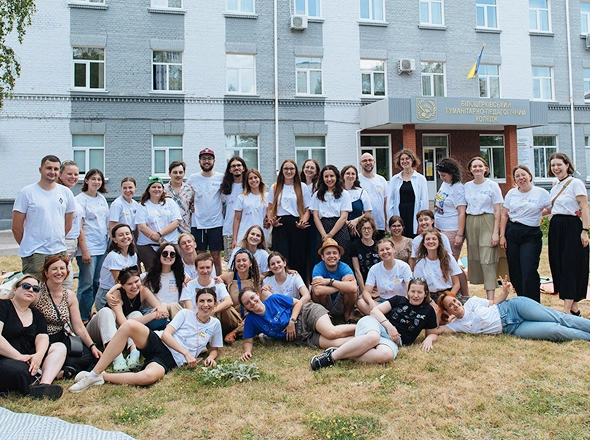
• Teach For Ukraine — represents local and national Ukrainian organizations and translates field-level evidence from affected communities and schools into coordination and decision-making.
The EiE TWG serves as an open platform for coordinating efforts in education in emergencies and supporting continuity of learning.
Teach For Ukraine represents national civil society organizations within the EiE TWG and, as a co-lead, helps ensure that decisions reflect the realities faced by schools and the education system.
In practice, this includes:
- Representing the interests and perspectives of local and national Ukrainian organizations that are part of the EiE TWG but do not hold a co-lead role;
- Delivering education programs for students, educators, and schools, particularly in the most affected regions;
- Directly identifying needs in communities and responding to them rapidly;
- Feeding evidence and field data into strategic planning and decision-making processes within the EiE TWG.