Admit it — did you dream of being a teacher as a child? Toys lined up in rows, a homemade pointer, and the feeling of absolute magic… At six years old, playing “school” felt like having a superpower. Standing at an improvised chalkboard, we were drawn to the role of leader — to seeing our “students” listen to us, to feeling capable of shaping the world. Teaching stood alongside conquering space and saving lives — it was a dream profession, built on a sincere belief in the teacher’s omnipotence and a desire to share knowledge.
But somewhere along the way to adulthood, that excitement fades. Today, behind the headlines about “a shortage of specialists” and “an ageing workforce” lies a more personal question: what happens to a childhood dream when it enters adult life?

“I’ll probably go into school… but I’ll see how it goes”
That is the most common response heard from graduates of teacher-training programs when asked about their future. Not a refusal — but not confidence either. More like a readiness to try, and a possibility to step back.
The study “Opportunities and Potential of the Teaching Profession”, conducted by NGO Teach For Ukraine, confirms this: most prospective teachers do plan to work in school, but only about a quarter are fully certain of it. The rest either have doubts, or see school as just a temporary stop.
Because alongside the dreams comes a sobering look at life. The income level in education determines not just material comfort, but the feeling of professional worth. Altruism is a finite resource. So when material stability is lacking, the image of the teacher-as-leader fades and begins to feel like an endurance test — where you give far more than you receive.
At the same time, young people talk about work in a noticeably different way than previous generations. Tenure and status rarely come up. Instead, the word “happiness” appears — as an important measure by which they evaluate the future. Two-thirds of over 700 young people surveyed named it as their benchmark for success.
Against this backdrop, schools present an ambiguous picture. Teachers are expected to do much — not just teach, but organise events, resolve conflicts, fill out reports. The main reason people stay in the profession is the children themselves.
In in-depth interviews with students, the teaching profession appears quite differently from childhood imaginings — not as a role of influence, but as a decision laden with uncertainty. Can teaching be a space for leadership? Can you find happiness there — happiness being the measure of success for most young people? We looked for the answer in conversations with those who chose to reclaim that very “superpower.”
Karyna Turova is one of those who remembers her childhood dream — and even has photographic evidence. In Horishni Plavni, Poltava Oblast, where she has lived her whole life, the family archives contain a special photo: a schoolgirl named Karyna standing at a “chalkboard.” The role of the chalkboard is played by a sliding keyboard tray, with the first English words chalked onto it. Next to her, on a small chair, sits a serious “pupil” dutifully writing down the young teacher’s every word.
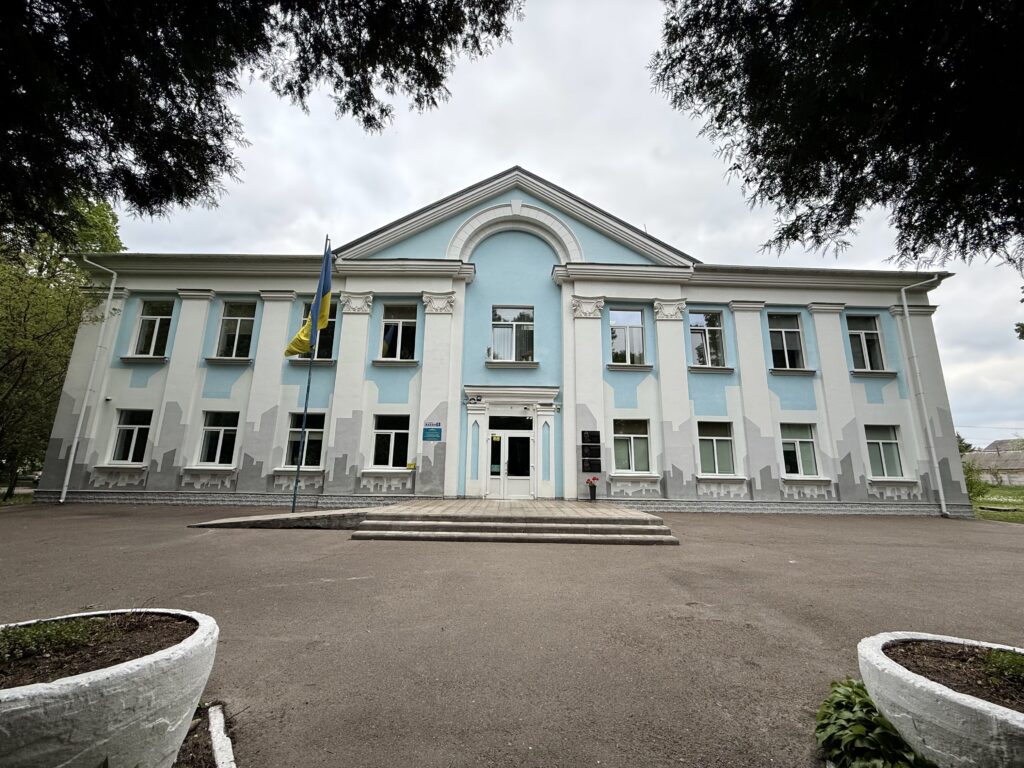
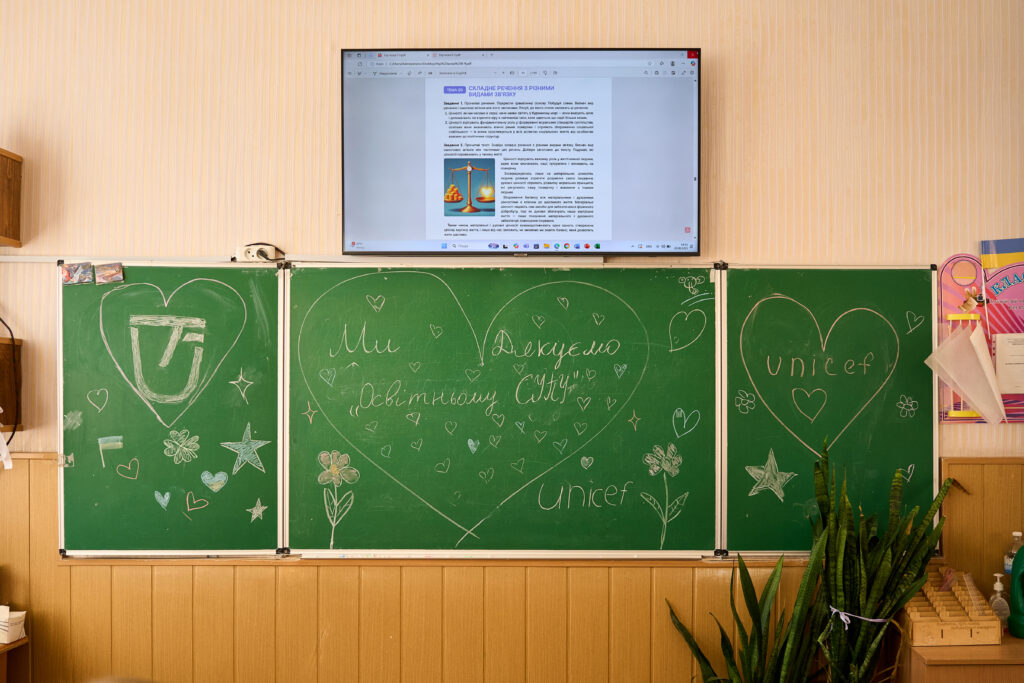
Today, Karyna teaches English at Horishni Plavni School No. 3. She works with children through the Teach For Ukraine Fellowship leadership development programme. Although she had already worked as a teacher and translator at Ferrexpo before joining the programme, Karyna decided to try entering the profession again — differently this time.


Alongside Karyna, three other young colleagues teach at the school — all of them graduates of that same school years earlier. Wanting to understand whether School No. 3 might enjoy the same “staffing success” again in the future, Karyna asked her students whether they dream of becoming teachers.
The sixth-graders grew a little shy, but happily shared memories of playing “teacher.” Nastia remembers how she used to picture it: sitting at her own desk in a classroom, teaching children of different ages. When asked why she wanted to stand at the board in a teacher’s role, she answered simply: “People listen to you more and pay more attention to you.” Milana also played school — with her younger sister, and as the elder one, she always got to be the teacher. She says a teacher’s superpower is “when they tell you something not from the textbook, but just from their head.” Bohdan played school with his parents. He still thinks about working in education.
In eleventh grade, things look different. Dasha says she used to dream of teaching “back when you don’t really understand what it is and how hard it is.” Her mind has since changed: you have to connect with children, and every child is so different. She now considers it an irrational choice for herself. Nazar only thought about it in early childhood — when he was passionate about drawing and helping his brother with sums. What might change his mind? “A higher salary, an easier curriculum… or if there’s no other choice.”
Nazar doesn’t yet know if there will be a choice. Karyna, when she chose teaching, was returning to her dream. Olia Levchuk, a Teach For Ukraine Fellowship participant, found her own path to teaching through her love of science — and this year stepped into her own classroom for the first time.
Olia loved mathematics for the thrill it gave her — that brief moment when an answer finally clicks and the world’s chaos becomes, for a second, logical and manageable. In primary school, she barely even noticed she was getting top marks. But by middle school, when it became clear that not everyone shared her interest, she transferred to a technical lyceum.
The lyceum was a new experience, where the quick pace of lessons energised the seventh-grade Olia. It was there, listening to the headmaster’s complaints about a catastrophic shortage of physics and maths teachers, that she first seriously considered her future profession:
“Maybe I should become a maths and physics teacher? I always thought about teaching. And I do well in both.”


Yet Olia, like thousands of talented lyceum graduates, chose the more reliable and familiar path of continuing her education. That was the Institute of Applied and Systems Analysis at Kyiv Polytechnic Institute — which welcomed her with the promise of a genuine challenge. She was told it was “the hardest faculty in the university” — and she “loved it when things were hard.” Then came Covid, followed by the start of the full-scale war. Instead of the excitement and lively interaction she had hoped for, Olia found herself doing the same laboratory assignments again and again, remotely.
The only bridge to reality during those years was private tutoring. Throughout her studies, Olia helped schoolchildren improve their maths. The attempt to “teach someone else” became her way of saving her own passion:
“University was somehow draining my love for the subject. At some point I caught myself wondering: do I actually still love maths? And then I would come to my students, explain a complex topic through simple analogies, and see that moment when a child says: ‘Oh, that’s actually easy!’ That was the moment I remembered I really did love maths.”
April 2025. Olia was almost a KPI graduate. It seemed her path into professional life, like that of her classmates, was laid between glass-fronted offices and cosy co-working spaces. Her family pushed her towards a master’s degree. But Olia felt exhausted. She needed a gap year.
“I wanted to take a break so I could love what I was doing — not just do it for the sake of it. And then decide what I needed next. Around that time, in April or May, I came across an announcement about the Teach For Ukraine Fellowship intake, and everything fell into place.”
Olia, who had been drawn to challenges since childhood, had no doubts. Through the Teach For Ukraine Fellowship, she went to Poltava Oblast to teach maths to children in the village of Omelnyk. The school where Olia now works is just a few streets from the Psel River, whose winding course around the village’s outskirts looks almost symbolically like an endless sine wave. There, 23 kilometres from Kremenchuk, the metropolitan anonymity that had been normal for Olia as a Kyiv native came to an end.


“I’d imagined a proper village — an old cottage — but I live in a flat in a two-storey building. My first shock was discovering that I didn’t know anyone here yet, but everyone already knew I was Ms Olia, the new maths teacher. It was a culture shock that this was even possible. I understood that in a village everyone knows each other — but it was unexpected that you could walk up to someone you’d never spoken to and immediately start a conversation.”
At school, Olia was greeted with the full range: from fifth-graders with their inexhaustible energy, to algebra and geometry in the upper years. Later, the eighth grade was added — twenty students, noticeably noisier than the ninth, where only eight teenagers sit at their desks.
The hardest part turned out to be not explaining the topic, but convincing students it was worth trying to understand it.
“I often hear: ‘No, I don’t get any of it anyway.’ Then comes the persuasion — just getting the child to believe it’s possible. There were moments when it worked — but it needs constant reinforcement.”
A similar confusion arises when the conversation turns to the future.
“Fifth-graders say it’s ‘too early’ for them to think about careers, and the ninth grade simply doesn’t know what it wants. I’ve never heard any of the children seriously talk about dreaming of becoming a teacher.”
Olia thinks about this not only as a teacher, but as someone who recently faced that very choice herself — and knows what it means to explain that choice to family.
“I think the teaching profession isn’t seen by society as a good one. Unhappy teachers who got worn down along the way, students’ parents, then friends — together they shape this image. Even when I told my family I was going to teach, I got a lot of pushback. I don’t know where it begins, but being a teacher is not considered prestigious.”
She recalls a remark she heard from a colleague: a student once said — “Why should I learn any of that? My dad didn’t learn anything at school, and now he drives trucks and earns twice as much as you.”
“I think that largely explains why teenagers don’t want to go into this profession. And it’s behind most of the problems teachers face every day.”
But the profession’s image is shaped not only by family, but by the first role models encountered outside the home. And here, Olia was fortunate. She would not be teaching maths today had she not met teachers at her lyceum who were passionate about their work — who competed for “Teacher of the Year,” attended courses, and shared knowledge beyond what the curriculum required.
What Olia speaks of as personal good fortune is something that Yaroslav from Kaharlyk is experiencing right now. An eighth-grader, he says he used to dislike computer science: lessons felt “boring” to him. This year everything changed: his teacher, Rostyslav Vernyhora, a Teach For Ukraine Fellowship participant, helped him see the beauty in the subject:
“Mr Rostyslav changed how I feel about learning — he’s open, fun, interesting. I just want to go to lessons more.”
As for the future, Yaroslav hasn’t decided yet — at times he wants to make games, then again he doesn’t. But he thinks he could genuinely see himself as a computer science teacher. And he adds:
“If I become a teacher, I’d want to pass on knowledge to children — languages, programming. And probably also hope.”
Olia sums it up:
“Younger children — up to about fifth grade — still see the teacher as an authority and a role model by default. But in middle and upper school they pick up those ideas about prestige from those around them. And by then most teachers are exhausted — and the children see it. I was lucky that at my lyceum it was different. I think that shaped my attitude towards learning — and towards who I want to be.”
Olia felt that her role in the school was to support the children. At first, much of her energy went into building a relationship with the seventh grade — a connection was forming, but not as close as she would have liked. Until one day, Olia mentioned in passing that she would be going home to Kyiv for the weekend.
“‘You’re from Kyiv?’ they said. And the questions started. It grew into a conversation about what they were planning to do, where they might study. You could feel that no one had ever talked to them about any of that.”

More conversations like that would be welcome — and time has to be consciously found for them.
“The hardest thing for me is filling in the register, doing the curriculum plan, thinking through a lesson plan. Because I can walk in and explain any maths topic off the top of my head without preparing.”
In January, new challenges came: hard frosts, power cuts, weeks without heating or water. It was then that Olia found a video showing how to make ice cream from snow, and suggested the experiment to her students.


“It turned out wonderfully — the children were totally absorbed, they did everything themselves and had an incredible time. We got cold, but we ate delicious ice cream. Because children replenish your energy precisely when you offer them something and they go with it. Those are the best moments.”
The findings of the “Opportunities and Potential of the Teaching Profession” study illuminate exactly this experience: seven out of ten young teachers say what keeps them in the profession above all else is the children. Not salary, status, or working conditions. But those same children — the ones whose company is draining, and yet who inspire, move, surprise, and keep reminding you why you are there.
The penultimate term of the school year is drawing to a close. Real spring has arrived outside — the kind you feel differently in Omelnyk than in Kyiv. Olia’s students have gone on holiday. Ahead lies the end of the school year and an open question: continue with the Fellowship for another year, or choose a master’s degree. But there are things Olia no longer doubts.
“I think teachers can be happy. I don’t try to capture happiness in a particular moment — I just enjoy what there is. But now, feeling the aftertaste, I can say: I loved being in the school as a teacher, especially the first term, which I’ve had enough time to reflect on.”
The smell of thawing earth and the first days without a warm coat after a long winter without heat or light — in that context, Olia recalls last April and how she weighed whether to apply for the Teach For Ukraine Fellowship.
“If I could go back in time, I would tell myself: apply — it’s worth it. The me of today and the me of a year ago are almost two different people. As for what I’d add about what you need to be prepared for… I’d say: ‘Olia, buy yourself a pair of rubber boots — you can’t do without them here.'”
While Olia teaches algebra and geometry to ninth-graders in Omelnyk, Kateryna Dovzhyk — a former SMM manager — stepped into a Ukrainian language classroom in Blystavytsia, Kyiv Oblast, for the first time. Karyna Turova, who had already worked as a teacher and translator at Ferrexpo before joining the programme, returned to school in the town where she was born — now as an education leader. And Kseniia Lentsova, previously a paediatrician who worked shifts at Okhmatdyt children’s hospital as a student, has now traded her stethoscope for chalk and helps students at Petrivskyi Lyceum in Kyiv Oblast break life down into cells and molecules.
What unites them is not a pedagogical degree, but a readiness to take on something genuinely difficult and important: work in schools in small communities where teachers are in desperately short supply.
A year in school becomes an intensive in crisis management and emotional intelligence: building relationships with thirty different children, adapting lesson plans around power cuts, finding the right words for a teenager who doesn’t believe in themselves. But no one is left to face those challenges alone. A mentor is always close by, along with methodological support and a circle of like-minded peers going through the same experience.
Whatever path the graduates of the Teach For Ukraine Fellowship choose next — social entrepreneurship, business, public administration, further study — they carry this “baggage” with them: the ability to hear others, a capacity for deep reflection, and a readiness for challenges forged in real life.
At six years old the answer is obvious: to be a teacher is to be the one people listen to, the one they copy, the one who knows more than anyone else. The Teach For Ukraine Fellowship exists for those who are ready to walk a path of leadership development and return to that feeling of influence and superpower — but this time consciously, with a full understanding of its true value.