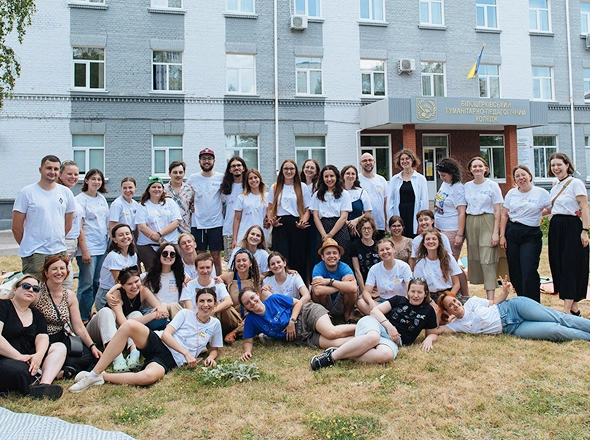
While in London, Natalia Etten, CEO of Teach For Ukraine, sat down with James Toop, CEO of Teach First (UK), for a conversation on education, teaching, and the role of civil society in times of sustained crisis.
The full-scale war in Ukraine has fundamentally reshaped the role of education, teachers, and civil society. Against this backdrop, the discussion examined how Ukraine’s education system continues to function, adapt, and support children under conditions of prolonged instability — and what these realities mean for education systems more broadly.
This conversation explored resilience, trust, humanity, and the strategic choices that shape education systems when stability can no longer be assumed.
Below are five key insights from the discussion.
Teach For Ukraine was founded in response to deep and persistent inequalities between urban and rural education. According to the available data from PISA, the learning gap between students in major cities and those in rural communities in Ukraine exceeds four years. The war did not create this disparity, but it has dramatically intensified it — particularly for children in frontline communities.
Reflecting on the organization’s origins, Natalia Etten emphasised that Teach For Ukraine emerged at a moment when Ukraine was already grappling with conflict and systemic educational gaps:
“Nearly nine years ago, a group of passionate young founders asked a simple but urgent question: how do we support children in rural communities who have far fewer academic opportunities, while also investing in their leadership and sense of belonging to the country?”
Initially, Teach For Ukraine focused on recruiting, training, and placing young, motivated leaders into rural schools for two-year teaching assignments, where students often faced a shortage of teachers and resources, or had limited access to most current teaching methods and role models who could inspire them early on. Over time, however, the scale of inequality made it clear that teacher placement alone could not meet the depth of need.
Reflecting on the different starting points of the two organizations, James Toop noted:
“Interestingly, Teach First began as an urban response and later expanded into more rural, coastal, and smaller towns. Teach For Ukraine, however, has the added dimension of working close to the frontline, with stark differences between regions in the east and west of the country…”
As Natalia explained, the full-scale invasion forced the organization to rethink its role within an increasingly strained education system:

“We have remained faithful to our original model because we see its impact year after year. At the same time, the war radically deepened educational needs. We realized that placing young teachers alone was no longer enough — the scale of loss required systemic work with experienced teachers, school leaders, and volunteers across Ukraine.”
This evolution reflects a broader reality of education in Ukraine: long-standing disparities have been magnified by war, turning structural inequality into an urgent national crisis that demands collective, system-level solutions.
For many Ukrainian students, COVID-19 was immediately followed by the full-scale invasion — resulting in years of education without classrooms, daily peer interaction, or a stable sense of school life. As Natalia Etten explains:
“An average sixth grader from southern Ukraine may never have experienced school as we know it — running through hallways, sitting next to a classmate, going to the cafeteria, or standing at the blackboard to present their work.”
This absence goes far beyond missed lessons. Children are not only falling behind academically, but they are also missing the social experiences that shape confidence, communication, and a sense of belonging. As Natalia adds:
“We are only now beginning to understand and address the consequences of lost socialization — a critical component of healthy child development. From COVID to the full-scale invasion, any sense of normalcy has been fundamentally disrupted for both students and teachers.”
The effects are profound, affecting both academic progress and social-emotional development alike. Ukraine’s already strained education system is trying hard to respond to these challenges at scale.
With limited state capacity, civil society organizations have assumed a significant share of responsibility for sustaining education. Teach For Ukraine has evolved from a teacher placement program into a multi-faceted organization that supports in-service teachers, delivers learning recovery programs, addresses trauma, and strengthens local education communities across the country.
Reflecting on the role of civil society, Natalia Etten highlighted the broader context:
“Our system was not equipped with additional infrastructure to support parents during this period. There were few tools to help families understand how to support their children in an extraordinarily complex environment.”
The gaps were not only systemic but also personal. Our schools often lacked the resources to train teachers in new tools and approaches. As Natalia explains:
“Adaptation was required from everyone — students, parents, and school communities. Gradually, and with varying degrees of success, schools began to respond: teachers sought training, administrators created new forms of support, and communities learned together.”
Civil society filled the crucial space left by the system. Natalia describes this collective response as a defining feature of Ukraine’s educational resilience:
“In Ukraine, we do not think in terms of ‘your child’ or ‘my child’ — we think of all our children. This inspires organizations to step forward and invest their resources where they can have the greatest impact. There are already several strong organizations in Ukraine working across different areas of educational support, and it is precisely through their collective efforts that our education system has been able to withstand extraordinary pressure.”
While short-term humanitarian interventions are essential, they are not sufficient to rebuild the system. Long-term investment in teachers — through training, emotional support, leadership development, and professional dignity — is foundational. In times of crisis, it is the teacher, not a tool or platform, who remains the most powerful factor in restoring learning, stability, and trust for children.
As Natalia Etten explains, Teach For Ukraine continues to place talented young educators in rural schools, but the focus has shifted significantly towards supporting systemic teachers already embedded in school communities across the country:
“We continue to place talented young Ukrainians in rural schools, but these placements represent a much smaller share of our work compared with the scale of support we provide to systemic teachers already working across the country. Our focus is particularly on educators in frontline communities in southern and eastern Ukraine, where schools have suffered the most severe damage and require the strongest support.”
Support for teachers includes targeted interventions, such as tutoring programs with ready-to-use materials that any teacher, volunteer, or parent can deploy to help students catch up across multiple subjects. Teach For Ukraine continuously pilots and refines interventions, learning from each experience to provide support that is precisely tailored to the needs of the communities we serve. Just one example is Wave of Inspiration — a training retreat where teachers step away from their usual environments to rest, recharge, and reconnect with colleagues and their purpose:
“We take teachers out of their usual environments, where exhaustion and stress can weigh heavily, and invest in them over several days with care, training, and connection. They rest, share experiences, and engage with tutoring materials and learning recovery strategies. There’s singing, dancing, hugging, and a lot of warmth and camaraderie — all of which helps teachers return to their schools renewed, bringing that wave of inspiration back to their communities.”
Through these efforts, teachers receive both academic tools and emotional support — reinforcing not only individual classroom learning but the resilience and capacity of entire schools and communities under extreme pressure.
Ukraine relies heavily on international support, but effective assistance goes beyond funding programs. It requires trust-based partnerships and investment in the institutional capacity of local organizations. Flexible, long-term approaches enable education systems not only to survive crises, but to become more resilient and future-ready.
Reflecting on the role of international partners, Natalia Etten emphasizes that their contribution matters not only financially, but as a demonstration of trust in Ukraine’s education system:
“A significant portion of our funding comes through multilateral and bilateral agencies, including various UN bodies. This support prevents countries like Ukraine from experiencing a total system collapse and ensures basic educational needs continue to be met.”
At the same time, she stresses that effective support must go beyond one-off grants and include strengthening local institutions:
“From my experience on both sides of this process, trust remains the key challenge, and I invest a great deal of my time and energy in building it. Of course, checks and compliance systems are necessary, but funding is far more effective when it leverages the knowledge of local organizations, who have a deep understanding of real needs on the ground. Funding coming to Ukraine should also invest in building institutional capacity so the system isn’t perpetually dependent on external support.”
Natalia also highlights the reciprocal nature of Ukraine’s engagement with the world:
“Ukrainians have an enormous capacity to support others and share what we’ve learned, not just to be constant recipients of aid. We have valuable — though hard-earned — experience, and we can give back our knowledge and expertise with gratitude.”
The conversation concluded with questions from the Teach First team that highlighted shared interest in leadership and teaching in crisis contexts. Participants were particularly curious about how Teach For Ukraine prepares teachers to lead amid uncertainty, integrates trauma-informed approaches into daily practice, and prioritizes focus when facing multiple simultaneous crises. Collectively, these questions underscored a broader interest in practical, scalable solutions — not just responding to crises, but building resilient systems and leadership capable of sustaining schools through prolonged disruption.