The world’s shortest manifesto of belonging looks like a solitary “+” symbol in a Zoom chat. When Mykola Overchenko begins a lesson with his student, the other end of the call is filled with silence and the weight of hundreds of kilometers of occupied territory. The next 45 minutes are their shared round in an invisible resistance against a system that attempts to erase a child’s identity every single day.
Mykola is a graduate of the Teach For Ukraine Fellowship, a leadership development program by Teach For Ukraine. Through this program, Mykola spent two years teaching history to children in the village of Zhukyn, honing his skills in pedagogy, leadership, and social impact. Today, he is an educational program manager at the Charity Foundation “East SOS,” a teacher at Berdyansk Gymnasium No. 16, and an author of educational materials. Mykola serves as a bridge through which Ukrainian education enters the closed apartments of an occupied city.
According to Mykola, teachers in the temporarily occupied territories who agreed to cooperate with the occupation authorities receive neither stability nor trust. They are often removed from schools or relocated deep into Russia. Ukrainians remain objects of permanent suspicion; thus, all efforts of the occupation administrations are directed toward ensuring the new generation becomes carriers of Russian ideology. Education there has one primary task: to normalize war, blurring the line between the classroom and the barracks—a fact confirmed by reports from international human rights organizations.
While the Russians turn schools into militarized incubators—where seven-year-olds are taught to pilot drones on the “Berloga” platforms and prepared for roles as “sappers” in “Zarnitsa 2.0” games—Ukrainian education has gone underground.
According to Kateryna Tymchenko, Project Manager at the Office for the Implementation of the New Ukrainian School (NUS), 34,174 children from the temporarily occupied territories continue to study in Ukrainian schools today. For many of these children, pedagogical patronage has become a safer way to remain within the Ukrainian information space.
Mykola knows well how this tool works and how the Ukrainian school system must compete with a massive machine of indoctrination. Despite the danger, children continue to return to Ukrainian online classrooms. This article explores why they choose this connection and how Ukrainian education is evolving to remain accessible to children under occupation — in the article below, as well as on the pages of the media outlet Eastern Variant
Mykola grew up in Berdyansk. In school, he was the type of student more often seen in the back row or the principal’s office than at the blackboard. He disrupted lessons and argued with teachers. The plot twist where he returns to his alma mater as a teacher was hard for even Mykola himself to imagine. Now, his former teachers have become his colleagues and mentors, and he is the one fighting for the students’ attention.


“I wasn’t the best student, and until the 9th grade, I was a terrible teenager. Now my colleagues say: ‘But you remember—you were so good!'”
After the start of the full-scale invasion, Mykola’s home gymnasium moved “to the cloud,” becoming a network of Zoom lessons and digital classrooms. But for the children growing up there, behind those browser windows is a school in a city that always smelled of the sun-drenched steppe and Azov sea salt. Berdyansk—a city of solstices and seagull cries—has been under occupation since February 27, 2022. Today, Gymnasium No. 16 operates exclusively online. In each of its 33 classes, approximately 30% of the students remain in the occupied territories.
Mykola was invited to work with these children by his former history teacher, Kateryna Oleksandrivna. His schedule now includes 24 hours a week teaching history, law, and civic education to grades 5–9.
The catalyst for this choice was experience gained before the full-scale war: Mykola worked as a volunteer in a frontline school in the Luhansk region, in the village of Novotoshkivske, which has now been completely reduced to rubble.
Mykola’s next professional re-evaluation occurred in 2021 when he joined Teach For Ukraine Fellowship. The program challenged him to move to the unfamiliar village of Zhukyn in the Kyiv region and become a teacher in a place where he had no “safety net”—no friends, family, or established connections. It was a controlled but serious exit from his comfort zone; while he had the program’s support, in the classroom, it was just him and his ability to cope.
“It humbles you very quickly: you either handle it, or you learn to handle it,” Mykola recalls. “Besides the community, Teach For Ukraine Fellowship gave me an experience that flipped my perspective. There was a certain romanticism to it: constant movement, challenges, and the feeling that you are living life to the fullest—even when it’s scary or unclear what tomorrow holds.”

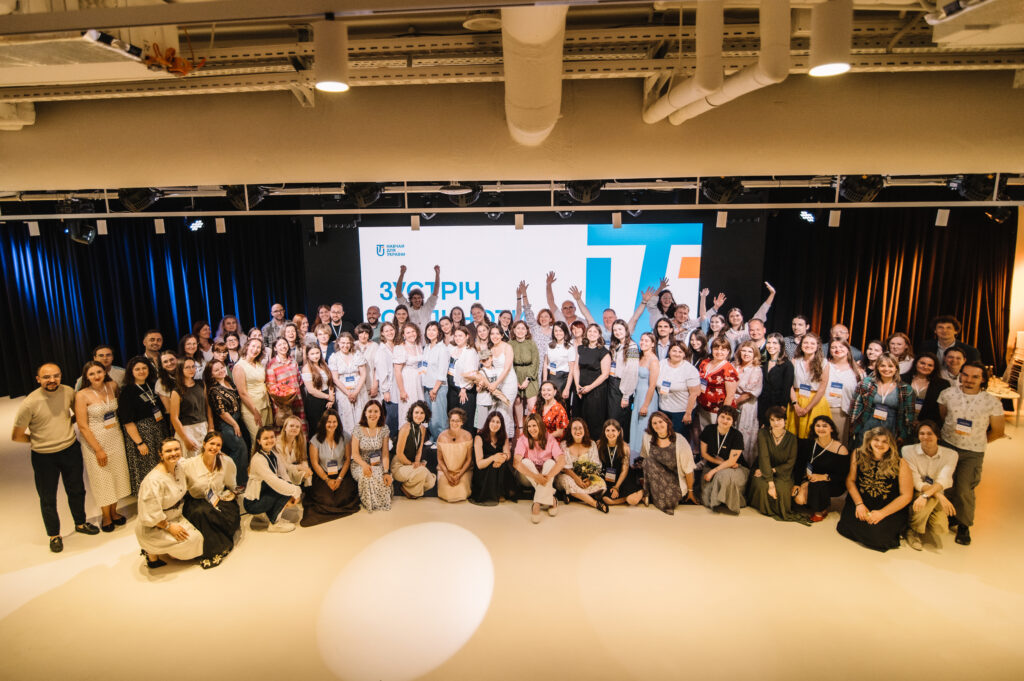
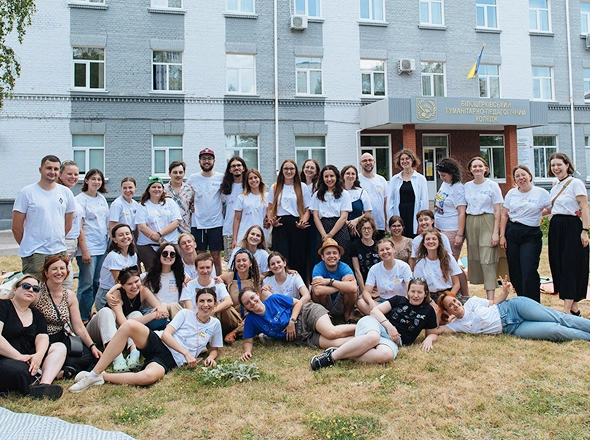
Mykola alongside Teach for Ukraine Fellows, 2021
When the full-scale war began, Mykola was in Zhukyn. Despite having the option to withdraw from the program, he chose to stay in education, remaining with the children to help restore learning “on adrenaline and nerves.” That was the moment he realized education was his “forever.”

“This experience helped me root myself in a simple thought: I finally know who I want to be when I grow up. And I definitely want to stay in education. In any role, under any conditions—as long as I am doing something real.”
Today, that “real” work has shrunk to the size of a monitor, where children from Berdyansk wait for him.
“Every lesson for me is a tug of war. Every time a child returns to me, I am the one pulling the rope. On the other side is a massive propaganda machine. I only have a few hours a week online. In every session, I am a friend, an entertainer, a teacher, a director. You never know if a child will return for the next lesson. It’s dangerous and not mandatory. But all the children come back to me.”
Mykola also continues to help frontline communities through the programs of the Charity Fund “East-SOS.”
“We work with schools affected by hostilities along the front line—the ‘crescent.’ We run various activities, mainly for teachers: training and workshops. For children, we have educational camps, including learning loss recovery camps like ‘Easy Camp.’ Most of the team are Teach for Ukraine alumni.”
There are several formats for Ukrainian education for children in the TOT. A standard distance school requires presence from 9:00 AM to 2:00 PM, which is practically impossible for those forced to attend a Russian school.
“The occupation school is a ‘school of coercion.’ If a child does not show up for more than three days, the principal is obliged to report it to the police. This carries the risk of searches and pressure for the entire family,” Mykola explains.
In these conditions, learning often becomes a family trade. In one of Mykola’s classes, a student’s mother and grandmother log into Zoom lessons every morning in her place. They take notes so they can relay the material to the child in the evening, after she returns from the Russian school.
To support families forced to maneuver for safety, the Ministry of Education and Science adapted pedagogical patronage.
Kateryna Tymchenko notes that while the tool itself is not new, it was only in 2025 that it was officially authorized as a tool for working with children in the temporarily occupied territories. Teachers can now work with students individually, tailoring the schedule to their security conditions.
Along with the legal framework, the content has also been updated.
“In July 2025, the Ministry of Education approved a Typical Educational Program for persons living in or who have lived in the TOT. This is the first unique document created specifically for these territories in 11 years of occupation and 4 years of full-scale war,” Kateryna emphasizes.
The program focuses on the Ukrainian studies component.
“At the same time, while studying under patronage, a child can choose the full standard program to master all school subjects if, for example, they are not forced to attend an occupation school. Occupation is not uniform: in some places, the authorities failed to resume in-person learning, while in others, unfortunately, children have been forced to attend these schools for years.”
Based on this typical program, 12 model programs were developed. Mykola Overchenko contributed to the creation of one of them—the “Civic Education and Foundations of Civil Protection” course.
Mykola’s Experience“The flexibility of pedagogical patronage is a lifesaver, sometimes literally,” Mykola explains. “We can change the lesson time if the power goes out or if there are checkpoints and inspections in the city. Patronage is about the Ukrainian education system adapting to the child’s life, not the other way around.”
During lessons, Mykola focuses on building trust and a safe space. The first twenty minutes are usually dedicated to something considered “unnecessary” in the occupation school—talking about the child themselves.
“Asking ‘How are you?’ is a basic thing for us. In Russian schools, no one is interested in the child as an individual; there, they are merely an object for ideology.”
Mykola notices how the war has fractured the experience of a single generation. Initial meetings with children from the TOT were often silent. While students abroad saw lessons as a chance to finally “talk with their own,” children under occupation started cautiously.
“They were afraid to say the wrong thing. Even now, a child might just put a plus in the chat for the whole lesson. It’s a way to be present but remain invisible. My task is not to push, but to provide the feeling that they won’t be punished for a mistake here. The experience children in the occupied territories are having right now is the most horrific experience one can endure.”
Patronage also allows for work with children with special educational needs who have been left without proper support under occupation, such as one of Mykola’s students. The format allows the teacher to officially adapt the program to the child’s pace.
“He doesn’t understand that there’s a war. He just says, ‘Everyone seems to have gone somewhere.’ His parents refuse to send him to the Russian school because his needs would be of no interest to anyone there. In patronage, we can talk about him.”
Children’s reflections on “normal life” are the result of long-term work in slowly building a space of trust. Mykola’s students take the opportunity to be heard—sharing their experiences, feelings, and hopes for the future.
“I think the Ukrainian school is a place where I can be myself. Because when I join the lessons, I feel like I’m back in ‘normal life’ again, not in some weird dream where everything is twisted. Even if we just say hello, even if my camera is off and I’m silent—I’m still ‘there,’ with my people,” says one of Mykola’s students.
“Sometimes I lie there and think: ‘I don’t want anything.’ Honestly. But when I log in and see familiar names in Zoom, it makes me feel warmer. Because here, you sometimes feel like you’re truly alone. But there, someone writes ‘hi’—and it’s okay.”
“Sometimes I lie there and think: ‘I don’t want anything.’ Honestly. But when I log in and see familiar names in Zoom, it makes me feel warmer. Because here, you sometimes feel like you’re truly alone. But there, someone writes ‘hi’—and it’s okay.”
When the conversation turns to the future, the answers become more guarded.
“I just want a normal future. So that I can plan, and it doesn’t sound like a fantasy. I want to study in Ukraine, walk down the street without looking back, so my parents don’t worry every day, so I don’t live with the thought of ‘what will happen tomorrow.’ I’m still thinking about who I want to be. But I know for sure that I don’t want to stay here forever and pretend that this is normal.”
As a Teach For Ukraine Alumnus, Mykola continues to embody the mission of Teach for Ukraine community: every child has the right to realize their potential, regardless of their place of birth or residence—even if that place is temporarily occupied by the enemy.
For him, every lesson with a child there is a “feeling of a weekly personal victory.” In a regular school, a teacher often doesn’t see the immediate fruits of their labor, but here, the result is measured by the very fact of the student’s presence.
“A child in occupation has a billion reasons to tell you ‘no.’ They aren’t obligated to connect. And when they find the opportunity and show up—it gives you the feeling that you aren’t doing this for nothing. Every such lesson means that today, we won.”
This victory is found not only in attendance figures but in the ability to doubt. In a system that demands blind faith in propaganda, Mykola teaches the opposite: to question everything, even his own words. This is the path to inner independence.
“When you start checking information in at least three sources—that’s when we truly win,” the teacher says. “It’s important for me to show that I can also be wrong, that I might not know something. Being a living human being who makes mistakes is a role model they lack over there.”
When asked if the students believe this isn’t the end, Mykola answers in the language of his profession—the language of history.
“I often remind them: no war of aggression in history has ever achieved a final victory. And I encourage them to verify even that fact, because the search for confirmation restores their hope.”
With this hope, Mykola and his students continue to meet every week—despite the danger, which remains a constant reason not to.