The World Bank has just published the results of the randomized controlled trial (RCT) on education, first implemented in times of war. Conducted with nearly 10,000 students across Ukraine through Teach For Ukraine’s Educational Support Program (Osvitnyi Sup), the study shows that lost learning can indeed be recovered — effectively, affordably, and at scale. The tutoring program not only delivered significant improvements in academic performance but also boosted student well-being, underscoring that education is a powerful tool for both learning recovery and mental health resilience. Crucially, the study showed that such interventions more than pay for themselves. These findings affirm that investing in education during a crisis is not only possible but also one of the smartest, most future-oriented investments any government or donor can make — with clear relevance far beyond Ukraine.

The study, initiated by the World Bank and implemented by Teach For Ukraine, was carried out in 2023–2024 in three waves with support from the UBS Optimus Foundation.
- Students participated in three hours of small-group tutoring each week in Ukrainian language and mathematics.
- Participants were randomly assigned to either the treatment or control group. Both completed baseline and endline surveys, but only the treatment group received tutoring.
- A distinctive feature of the program was its dual focus: academic support combined with attention to children’s socio-emotional well-being. Tutors were public school teachers who were trained in tutoring.
- Improved learning outcomes. The impact of tutoring in mathematics through the program was 1.2–2.4 times higher than in comparable studies in Europe during COVID-19.
- Lower stress levels. Students who attended classes regularly showed consistent reductions in stress.
- High engagement. Despite power outages and internet disruptions, more than two-thirds of participants attended online sessions regularly.
- Cost-effectiveness. The program proved to be a solid and effective investment in human capital, even during wartime.
- Scalability. By using existing infrastructure, the program can be scaled to the national level.

“For us, this study carries a double significance,” says Anastasia Donska, Head of Education Recovery Program at Teach For Ukraine.
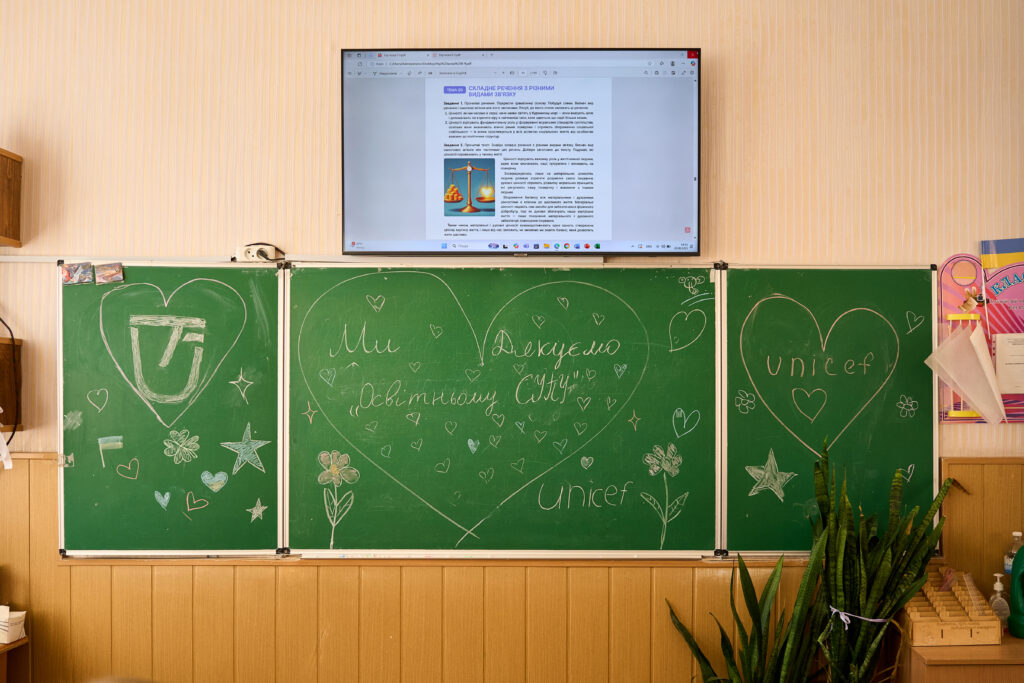
“It proves that even in the extremely difficult conditions of war, investing in children’s education is possible, effective, and impactful. In just six weeks, students made measurable academic progress, felt less stressed, and became more motivated to learn. It also sends an important signal for public policy: education must remain a priority even during war. Every hryvnia invested in a child today pays back many times over in the form of prepared, educated, and resilient citizens who will shape the country’s future. We see that the Educational Sup program — free remedial classes for schoolchildren, launched in 2022 and serving as the basis for this study — not only provided knowledge but also gave children a sense of support, community, and confidence in their own abilities. This research shows that investing in human capital during war is not only possible but critically necessary for Ukraine’s recovery.”
The cost–benefit analysis conducted within the study confirms that investing in human capital must remain a priority, even in wartime. Most existing research in conflict settings focuses on post-war recovery. The findings of this RCT show that it is possible to adapt and deliver educational support in the midst of large-scale disruption. Postponing action until the war is over risks deepening educational inequality and delaying recovery.
The full study is available here.