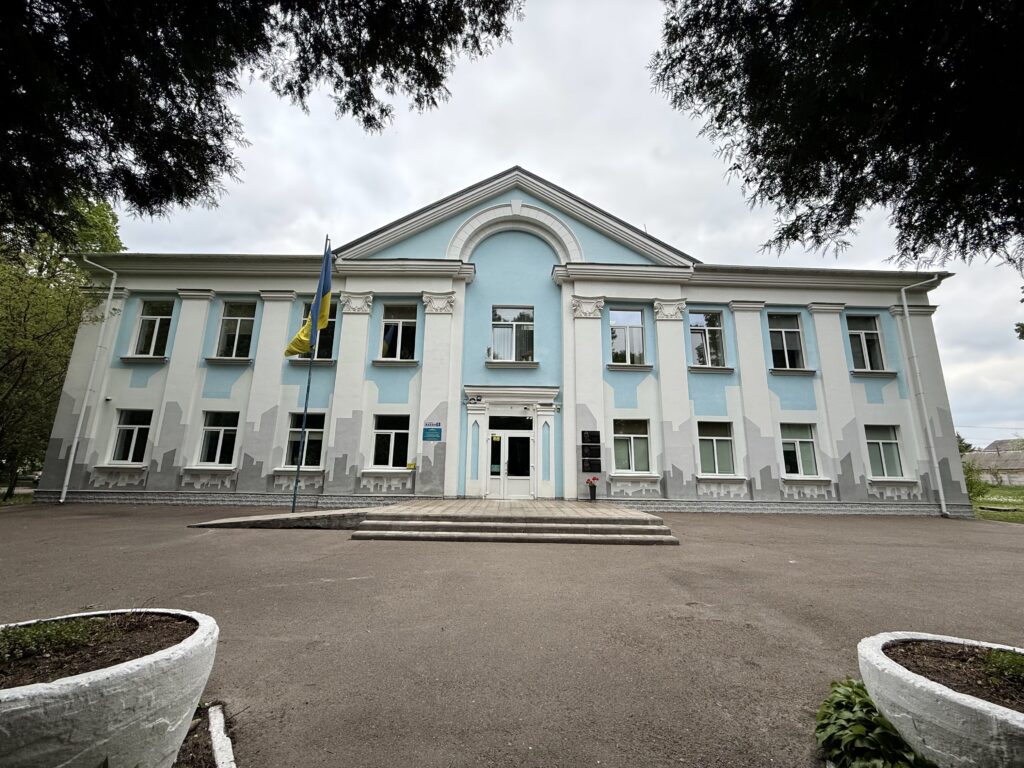
Zaporizhzhia is among the top three Ukrainian cities for the highest number of air raid alerts: since February 2022, nearly 7,000 sirens have sounded here. The city lives in a state of constant anticipation—sirens, power outages, and buildings shattered by enemy shelling. Among them is the “Dzherelo” (The Source) boarding school. This institution serves children with hearing impairments, musculoskeletal disorders, and Down syndrome. In September 2023, the school building was struck by a UAV.
But the school did not vanish. It dispersed across the city—into libraries, youth hubs, and temporary spaces secured through private agreements. Some children study online, while others attend in person wherever it is possible and relatively safe on a given day. The educational process no longer has a fixed address, but it has the people who sustain it.
Teachers, administration, and students teach and learn despite circumstances that leave almost no room for optimism. This is happening against a backdrop of massive losses to educational infrastructure. According to the Minister of Education and Science, Oksen Lisovyi, as of October 2025, one in six educational institutions in Ukraine has been damaged or destroyed. This represents over 4,358 institutions, 2,046 of which are schools. Behind these numbers are thousands of children and educators for whom the question of “how to return to school” no longer has a simple geographical answer. There is simply nowhere to return to.
So, how do those who cannot learn without in-person interaction, yet have no building to return to, restore offline education? This is the story of a school where educators work with disproportionate ingenuity and effort. Teach For Ukraine helps find new anchors in the educational process—through the Tutoring in Schools program, the project team provides teachers with tools to address learning gaps so that children can gain the basic knowledge essential for life.
Being ThereOleksandr Zhuk has worked at the “Dzherelo” boarding school for over sixteen years. During this time, he transitioned from a career as an economist to an informatics teacher, became the best teacher in Europe, a deaf education specialist (surdopedagogue), and the Deputy Director for Academic Affairs—the person upon whom the educational process rests in critical moments. Before the full-scale war, the school had 340 children. Today, about 260 students continue their education in various formats.


When the full-scale war began, the choice of “whether or not to go to work” did not exist for Oleksandr. Children were at the boarding school 24/7, and on the morning of February 24, they needed to be woken up, fed, and comforted—just as they were every day before.

“I left home at 6 a.m. I noticed many cars at the gas station. I read the news and realized a full-scale war had begun. My wife and child were at home. But I had to go to work so that these children wouldn’t be left alone”
Some parents, whose children stayed at the boarding school round-the-clock, found themselves under occupation; others could not reach Zaporizhzhia quickly.
“For a while, there was a corridor between the territory controlled by Ukraine and the seized cities. Some parents left the occupation, picked up their children, and returned back to the occupied areas. Because they didn’t understand what to do here. No housing, no jobs. For example, people with hearing impairments: if they communicate in sign language, they naturally go to their comfort zone, where everything is familiar. Of course, it was dangerous. They understood that. But it felt as if there was no choice”
In the early days of the war, the school became a hub: children were brought here from Mariupol, Berdyansk, and boarding schools in other temporarily occupied cities. Evacuations were happening simultaneously—helping some go abroad, handing others over to relatives, or temporarily placing them in other cities. All this happened without prepared instructions or scripts—only with the understanding that children could not be left alone with the war, and their families needed support.
After the drone strike on September 16, 2023, the school lost nearly five thousand square meters of space, leaving it defenseless against the elements. Corridors, classrooms, and modern equipment—3D printers, robotics, multimedia classrooms, and a radio studio—were incinerated. Oleksandr recalls the stifling smell of damp plaster and burnt plastic. He and the teachers turned into rescuers, trying to beat the rain in the twilight.
“When the prolonged rains began in Zaporizhzhia, the building flooded from the third floor down to the first—there was no roof. My fellow teachers and I would come after lessons to bail out the water, hoping that something could still be saved, and perhaps one day, rebuilt. Eventually, we stopped bailing—it was too difficult to combine it with the teaching process”

Since 2023, the educational process at this school has been a matter of constant planning and organized movement. Children study in different formats: some remotely, some offline, as regularly as the security situation allows. For children with limited mobility, “pedagogical patronage” is organized—teachers visit them at home. Every Friday, Oleksandr plans the following week: where and with whom offline classes can be held, how to stitch together locations, transport, shelters, travel time, teacher availability, and student needs. He visits several points across the city daily—checking if everyone arrived, if it’s safe, and if they can continue. Education here happens not “by the schedule,” but in spite of the circumstances.
“We continue to support a blended learning model because it was clear even during COVID: distance learning for children with Down syndrome is impossible. The situation is similar for children with total hearing loss: you cannot convey sounds or the positioning of speech through a screen; you need to be physically present, to literally ‘get into the mouth.’ Over the last five years, the situation has worsened: children do not know full sign language and have speech articulation problems,” says Oleksandr.
In classrooms where children with hearing impairments study, the air is filled with the rhythmic movement of hands and the rustle of clothing. When children speak in sign language, one hears sharp exhalations and light claps of palms. Oleksandr explains: for them, it is vital to see not just a gesture, but the vibration of the throat, the movement of lips, and the tension of facial muscles. In a world where sound is muffled, meaning is conveyed through touch and sight—something no Zoom screen can replicate.
“That’s why we looked for ways to communicate at home: parents gathered small groups—6–7 children with Down syndrome, up to 9 with hearing impairments. First COVID, and then the war, greatly intensified all these challenges”
Since then, every lesson in this school is the result of collective invention, patience, and a readiness to act. To sustain the educational process and make it more effective, Oleksandr sought opportunities to help organize learning in these new conditions. This is how he met Polina Vasyleha, a tutoring trainer and coordinator of the Tutoring in Schools program implemented by Teach For Ukraine.
“If Not Us, Then Who?” Polina’s first introduction to the “Dzherelo” boarding school was unlike any typical visit to a partner school. It was an encounter with a place that looked intact from the outside but bore all the scars of a past catastrophe inside. The building stands approximately 28 kilometers from the front line—so close that debris from intercepted missiles falls directly into the courtyard. The administration, library, medical service, and some teachers still work in the surviving parts of the school.
For Polina, this space evoked a painful sense of recognition. Before joining “Teach For Ukraine,” Polina lived and worked as a teacher in Lysychansk, Luhansk region. Her own home school, where she began her educational journey, was burned down. This physical sensation of a “home that hurts,” the smell of charred remains and damp concrete, made Polina realize: she was there as someone who knew this experience personally.


“Walking through the school in Zaporizhzhia felt like a flashback—as if I were back home. The similarity was striking. I kept thinking: I can’t believe I’m entering this school again. I asked the deputy director of ‘Dzherelo’—what sustains your enthusiasm? She said: the children, because if not us, then who? Who will be with the children?”
The collaboration with “Dzherelo” was the first experience for the “Teach For Ukraine” team working with children with special educational needs (SEN). This story immediately forced them to seek a new lens, which eventually grew into a systemic strategy: the organization is now synchronizing efforts with experts to scale these methods, create manuals for inclusive classroom teachers, and involve more specialized schools in the project.
The foundation for this work was the expertise of the “Dzherelo” educators. When they came to learn tutoring, it became clear: the logic of “we teach—you implement” did not apply here. “Dzherelo” employed specialized educators—teachers with knowledge of sign language and speech therapy, and years of experience working with the hard-of-hearing, children with Down syndrome, and those with physical impairments. The tutoring team began to lean on this expertise from the very first steps.
“It was expectedly difficult. After meeting Oleksandr, I immediately wanted to learn sign language,” says Polina Vasyleha. “The thought crept in: if we know international languages, if we learn English, then we should learn sign language too. We learned many things from them, even though they came to us for training”
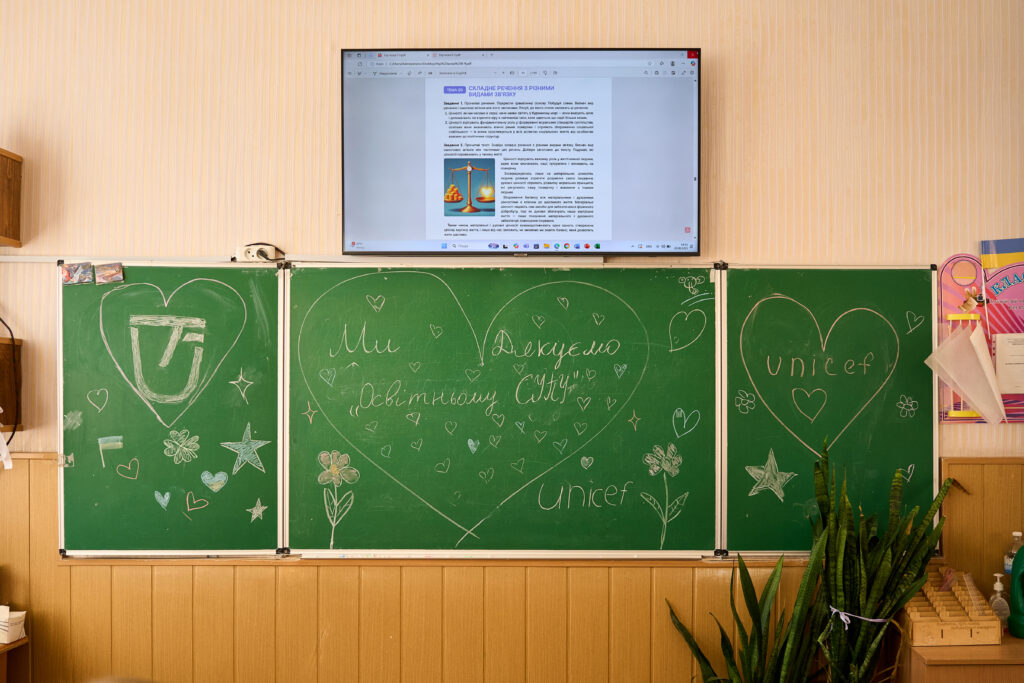
During their joint work, knowledge-recovery sessions based on the tutoring approach were adapted by the “Teach For Ukraine” training team specifically for children with SEN.
“There is a certain specificity when Oleksandr conducts informatics classes. His group has many hard-of-hearing children. It is difficult for them to read large texts. Reading is like a small child starting to speak—only a mother can interpret that speech. So, it was important for most tasks to be schematic. Informatics involves many algorithms. We realized that our ‘catch-up’ manuals, developed by Teach For Ukraine team, required more visualization to work for children with Down syndrome”
A separate challenge was communicating with the children to explain the purpose of the extra sessions and the concept of tutoring itself, as the sessions involve not only academic recovery but also soft skills development. Some children found it difficult to work with planning and development tools; the basic “development map” met with resistance and confusion. Polina Vasyleha attributes this to the context of the war.

“In the conditions of war, it is very hard for children to dream. Both neurotypical children and those with special educational needs find it difficult to answer the question: what do I actually want?”
During one visit, Polina observed a chemistry lesson and noticed the teaching style of a teacher working with neurotypical children. She repeated tasks several times, spoke slower, and sometimes—drawn out, as if leaving more time and space for understanding between words.
“Mr. Oleksandr explained to me: careful, slow, simplified speech, even with neurotypical children, is a result of constant work with the hard-of-hearing. A kind of professional deformation occurs in teachers.”
According to Polina, working with children with special educational needs changes not only the approach to teaching—it changes those who work with them.
“My Opinion Matters” Today, sessions based on the tutoring approach take place at “Dzherelo” with the support of the “Teach For Ukraine” team. These are additional lessons in the Ukrainian language and literature, mathematics, and history. Beyond this, using tutoring tools, the school’s educators teach children Ukrainian Sign Language: before the full-scale war, children used Russian Sign Language.
Behind every adapted informatics algorithm or simplified Ukrainian grammar rule is not just an educational goal, but an attempt to restore a connection to reality. In a world where the power is often cut and lessons must be held in shelters, the children of “Dzherelo” learn more than just subjects—they learn to feel their own value.

“Whatever I say—it’s my opinion, and it matters to me,” says one student. In these words lies perhaps the greatest victory of the tutoring approach: giving a child the right to be heard, to express themselves, and to have agency.
For some, the right to make mistakes was paramount. “We analyzed mistakes and weren’t afraid to make them. It was special that they explained exactly what wasn’t working to each person, and no one was in a hurry,” another student shares. In a school where learning happens despite blackout schedules and shelling, the absence of haste becomes the highest form of care.
The war constantly reminds them of its presence: “Sometimes during classes, we sat without light in the bomb shelter. It’s inconvenient because we couldn’t write,” recalls one of the “Dzherelo” students. But even in this volatility, children strive to define their desires. They make plans for years ahead, learning to filter out the unnecessary, leaving only the most important and desired: “The most special lesson was when we analyzed the wishes of fairy-tale characters. And then we finally wrote our own wishes for three years ahead.”
A special place in the sessions is reserved for working with emotional states. One student was surprised to discover: “Emotions aren’t good or bad. It all depends on how I show them.” In a city where fear is a frequent companion, this knowledge becomes an internal anchor.
In Ukrainian Sign Language, the word “hope” is a movement of both palms from the chest upward, as if something inside is unfolding and reaching out. It looks like the beat of wings before takeoff. At “Dzherelo,” this gesture takes on a particularly poignant meaning. Someone lost a home; someone lost their usual way of hearing the world; someone lost a sense of a safe tomorrow and the ability to plan.
One student, sharing his impressions of the classes, remembers: “What I remember most is writing down goals for the new year, 2026. It was hard to choose ten at first, filter out five of them, and then leave only the three most important ones.”
These three goals, written by a child during the largest war in Europe since World War II, are the symbol of hope.
We all resemble birds with clipped wings right now: to fly, we critically need someone beside us. Someone with one intact wing, someone ready to share the wind current and maintain balance during the next air raid. In this interdependence—teachers bailing water out of classrooms, tutors teaching how to dream anew, and children continuing to learn against all odds—a shared strength is born. Because when we become wings for one another, the sky becomes reachable again.
The school’s address may change. The people—remain.